Sunday, 4 May 2014

Did You Know That...?

Well, as my travels through Myanmar have sadly (and abruptly) come to an end, here’s some fun, weird and simply jaw-dropping facts I’ve come to witness first hand.

For one thing, everybody wears a skirt. And I mean everybody! Hell, I probably looked like a deranged person for not having a longyi, which would have been the norm for both sexes. Even the gold leaf pounding guy had one while pounding away at thinning the gold leaf:


Motorcycle drivers across the country, government officials and beggars, kids, monks and nuns and, of course, women of all ages, all wear their traditional skirts. Look at these guys curiously ogling the ferryboat:


And how about this guy, carelessly rowing through the floating gardens of Inle?


Let’s just say it’s a really, well… airy country.

And the only other place where I’ve seen so many Children of Bodom t-shirts was a medium sized European hard rock festival. They just love that black, dangerous feel they get from those shirts, and the death metal t-shirt – longyi combination is simply a fashion statement.

The trip to the swimming pool was also illuminating. The murky bluish waters of the pool are as inviting as a crypt and the smell of fresh disinfectant might just turn you into a happily intoxicated zombie but once you plunge into its depths, you’ll find yourself at a loss on the proper direction of swimming. It would make sense to swim the length of the swimming pool but only if you weren’t in Myanmar. Here it’s common sense to swim the width of the swimming pool, about a third of its length and there are carefully marked lanes for that. But I repeat: you’d have to be in Myanmar to experience that.

The length is in front but do you see which way the kids look?
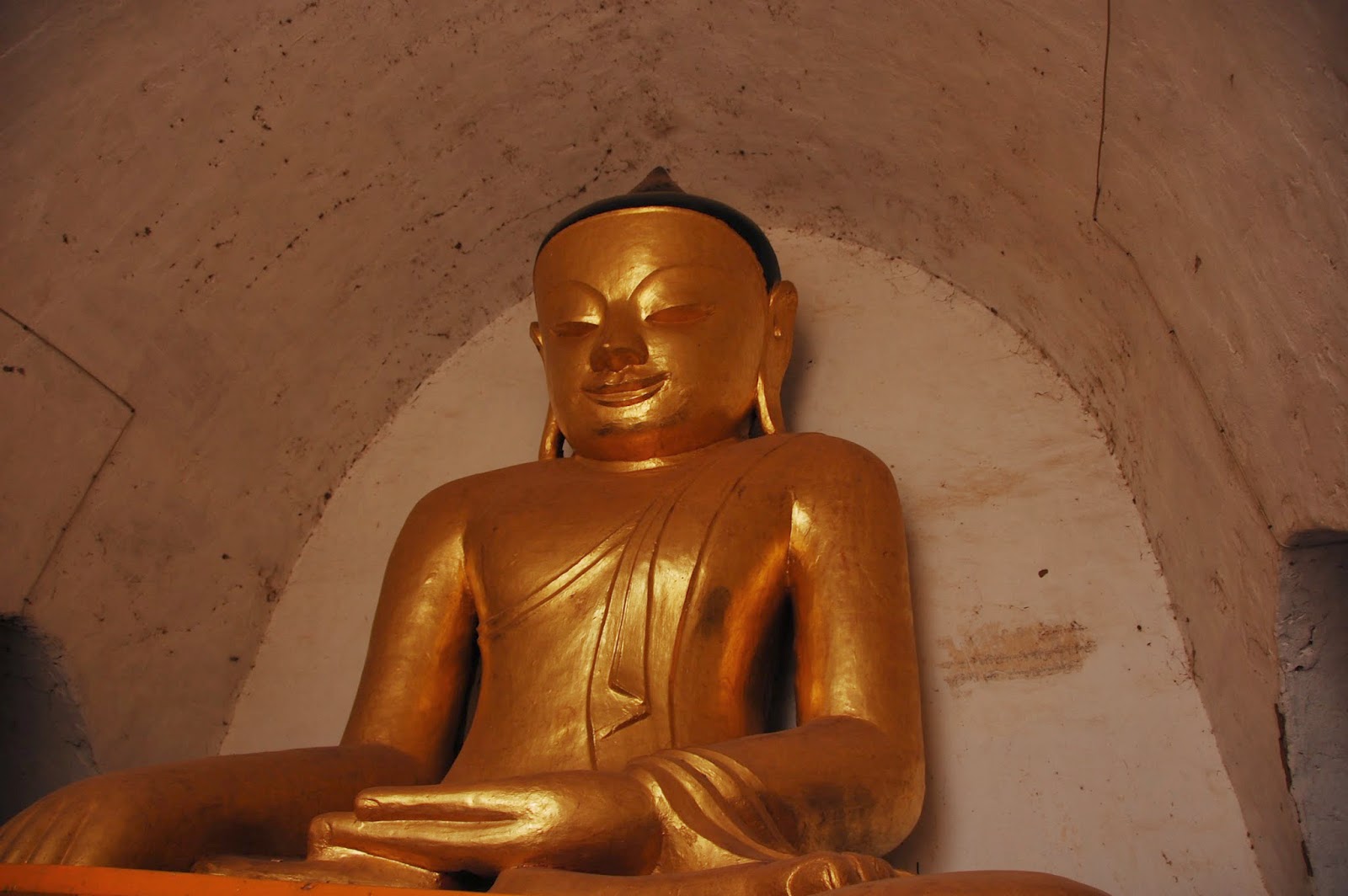
Lastly, there are the temples. Again. Because the temples are a big part of the country and so much orbits around them. Specifically, everything revolves around the Buddha statues. And, oddly enough, there are not many Buddhas that look alike. The images differ not only in appearance (surely because they have been fashioned according to their respective era) but also in expression, and so the serene, unattached yet benevolent Buddha can turn either into a puppet or into a clown. Just watch this:

Something-smells-funny Buddha

Robot Buddha

Surprised Buddha

Female Buddha

Tired old Buddha

Golden chunky Buddha, who gained over 2 tons of golden weight
from the gold leaf applied each day only by men

Sideways glancing Buddha. And driver.
 And my personal favorite:

Snot-nosed child Buddha
And if that’s not enough, just look at what other temple guardians they have:


The very last Burmese image that will stick to my mind dates from the airport in Mandalay, where, before boarding on the plane to Bangkok, I did a little exploring hoping to find a place to have a smoke. And following the ‘VIP Lounge’ sign, I stumbled upon this:


I couldn’t say if that’s the VIP Lounge but it’s definitely a smoking lounge tucked away at the back of the duty free shops, where Burmese life goes on as it has for centuries. And this is why I loved this country!

Friday, 2 May 2014

Why, Katha?

I left Hsipaw on a lonely bus towards Mandalay. I wasn’t feeling all that bad in the morning but, as soon as Mandalay’s hot and parching air hit me, I started feeling a little queasy. I would later learn that the fishy soup refused to be digested and was still slurring around in my stomach.

Mandalay is a big city. I haven’t seen it yet but even its map with its tidy network of streets looks intimidating. And, although I asked where in Mandalay the bus would stop, my question was eluded with ‘to main bus station 2000 kyat’. And, true enough, as I got off the bus, a gang of motorcycle taxi drivers charged at me. I fled and asked at a ticket counter where I could find a bus to take me to Katha. I was explained that I would have to go to one of the three main bus stations in the city and that I would be given a ride by a motorcycle taxi. The lady pointed to one and he rapidly led the way.

‘Wait’, I said. ‘How much?’
‘Bus station very far away, 11 km… 5000 kyat’, said the driver with the lopsided smile and hat respectively.

I only laughed and sat down to consult my 3-year old information from the guidebook while he quickly came to a 2000 kyat standard price. The guidebook said something about shared taxis that drive between the major bus stations and, although really crowded, are a better deal than anything else. I considered my options. I remembered that, worst case scenario, there was a train to Katha around 4 PM. So I looked for the shared taxis. Everywhere I went, private taxi drivers, whether on motorcycles or cars, tried to shove their services down my throat as I constantly said ‘shared taxi’. Their response: yes, taxi!

‘No, no! Shared taxi’, I retorted.

But every time they seemed to not understand what I said. After a while I suspected foul play and concluded that they didn’t want me to get a shared taxi. So I asked around some more. Finally, someone told me to wait for about 15 minutes and he’ll show me. I obediently sat down and waited but those 15 minutes! Sheesh! I forgot that minutes may differ in length and number in Asia, so it was no surprise that after a good half hour nothing showed up. I told the guy I was willing to go with a motorcycle taxi, he laughed and showed me a driver who could take me to the train station. That’s right, in the meantime, I decided I was going to take the safest bet and ride the train. The motorcycle taxi only cost me 2000 kyats.

I finally got to the train station all sweaty and lethargic and got a ticket for the 2:10 PM train. The afternoon one was already full. I would understand why some 13 hours later when I arrived in Naba, the place where I had to get off for another bus ride to Katha. The bus ride into town only took about an hour, which meant that by 4 PM I was sitting on a bench on the riverfront in Katha waiting for one of the assortment of available guesthouses to open so I can take a nap. I soon changed my mind and decided I would sleep on the bench, and so I did… for about 5 minutes until a guesthouse unlocked its doors.

Temptation was too strong: I asked for a room, got a 2x2 and instantly went to sleep. I woke up prepared to take it as it comes and, looking at the watch, I realized I still had 10 minutes to catch the boat further north. I went into Supertourist mode, packed fanatically, brushed my teeth and went out. But, as luck would have it, my passport was still at the guesthouse people awaiting a photocopy for their collection. Although I tried to explain that I really-really-really wanted to catch the boat, they told me to wait, made some phone calls and, smiling, went about their business. And, sure enough, as soon as I saw the boat leave the little port, the guy bearing my passport showed up on his motorbike beaming at me with a photocopy in hand.


So I ask you this: why, George Orwell? Why did you pick this godforsaken place as the stage of your book? Why is it that I can’t find even one of the buildings you described in your book? Why, George Orwell, why?

Thursday, 1 May 2014

Supertourist

I am proud to announce that I have been promoted to the ‘Supertourist’ status! And, if you were to ask what that is, I’d try to explain through examples of the Supertourist ways, which are above and beyond the normal tourist behaviour (there is no ‘ordinary Supertourist’, as Supertourists are, by definition out of the ordinary).

For instance, if given a train, Supertourist would gladly dangle over its sides while slowly being transported over Myanmar’s longest viaduct, the Gokteik Viaduct. Fortunately (or, maybe not), the train almost crawls over the viaduct because it appears that it creaks and contorts and is approaching its golden years even without the added stress put upon the structure by passing trains. But I’m glad to say no Supertourists found their end at the bottom of the Gokteik Gorges.

For Supertourist there’s nothing that’s not worth exploring. Even if Supertourist has only two short minutes at a train station, he will jump off and have a long look around: the new place might have something worth visiting so that any predetermined plan is completely useless. Hence, one more reason to travel light.

And how would Supertourist choose a guesthouse in any location? Would he use a guide book (like the ill-omened Lonely Planet) or follow the advice of other travellers? It would be a lot easier to have a quick stroll from the train station and look around for any prospective hot spot. Or, if the little flock of workers for a certain Yee Shin Guesthouse in Hsipaw would swarm around and thrust business cards in his face, Supertourist might just consider going there (especially since the 150 m ride is free). Even Supertourist might fall for your normal guesthouse owner/worker scheme: they say they have $5 rooms but first they show him the $6 rooms and if somehow Supertourist forgets to ask about the price, he’ll only find out once he checks out (incidentally, this is probably the first guesthouse in Myanmar where money is expected at the end rather than before checking in).

But Supertourist won’t mind. He’ll just make the best out of the remaining hours of daylight, rent a motorbike and drive around, exploring as much as possible. He would find the Shan Prince’s Palace, where a relative of the prince would sit him down and explain in great detail all the trouble the Shan Prince and his family have been through (and it’s quite annoying when you discover that Shan princes aren’t that rare, as there used to be 33 Shan states that required their own personal prince). Most probably, Supertourist will eventually faze out and nod whenever it is required but the majority of royal life details will be lost on him. He will then continue his adventure, finding the good sunset spot and hastily making his way there, only to find that the sun had already set and there’s not a lot to see as night falls rapidly over the valley. Still, there would still be some time to wonder through the little alleys on top of the hill, perched high on his motorbike, trying to copy the local ways by not getting off the motorbike without a serious obstacle in the way: temple gates or temple entries are not to be considered a serious obstacle. And, if questioned, he will invoke the ‘ignorant westerner’ argument, causing pitying or superior looks from locals.

Supertourist will take advantage of a new day from the early hours of the morning and, as soon as possible, he’ll ride around on the rented motorbike carrying a hand-drawn map of the surroundings and trying to find one of two waterfalls in the area, specifically, the one that’s not dried up. And, as success fails to show itself, as the non-English speaking locals will point him in the wrong direction, and as the roads become dirt tracks going steeply up a hill or another, Supertourist will stubbornly press on and will finally sneak a quick look at the secluded waterfall. The bike will be parked as close as possible, pictures will be taken and showers will be enjoyed.

But this will not be enough for Supertourist: he will want to know where the water is coming from, thus he’ll try to ride the bike up the hill, on a dangerously abrupt cattle path and through the crops on top, right up to the little farm suspended on the cliff above the waterfall. Having fulfilled his wish, he will have to descend on the same road with the bike, which will be the cause of some sweating and stress, soon to be forgotten by the approach of the Highway to Mandalay, from where new adventures start.

His aplomb will slightly fade when the bike’s chain will fall off the front sprocket and, being on the side of the highway with a tool-kit as useful as a fork for eating soup, he’ll have to flag down a nice Burmese mechanic who will not only reattach the chain but also tighten it as well. Spirit up again, Supertourist will start looking for a way towards the hot springs so lovingly portrayed at the guesthouse and, after a few failed attempts he’ll finally find a possible, if not probable way to get there. The overflowing river will never be able to dent Supertourist’s spirit: he’ll be up to the challenge and drive through the water as smoothly as a ballerina on a stage and reach a new and interesting sight: a stone quarry, where a dozen men are conveniently taking a break from crushing rocks with bamboo-shafted hammers and curiously eyeing the newcomer. Once he’ll ask about the hot springs, they’ll point to the river and indicate walking through it not far. But if Supertourist doesn’t fully trust walking barefooted through water on slippery rocks, the workers will soon explain that there is another way and will eventually guide Supertourist to the place. If the hot springs are still eluding Supertourist, he’ll accept the new-found spot, walk back through the river, watch how some huge slabs of stone almost come crushing down on his motorbike, and then drive to safety. He’ll soon arrive in the city, where he’ll try to find new hidden treasures.

Supertourist is not infallible though and needs sustenance. So, Supertourist must go out to find a restaurant for his special needs, for instance, a place that allegedly has vegetarian food. Upon ordering, he makes sure that the message is clear but once the food arrives and Supertourist has a bite, he’ll be struck by the distressing fishy taste of the broth where some noodles and veggies float and, being hungry after a full day, will ignore the fish soup and have noodles. As a consequence, Supertourist will be reminded of his fishy encounter the following day…


Supertourist’s day will end late, only to begin early the next morning, when the early Shan market must be visited before the 5.30 AM bus takes him away. Getting up at 4 AM is no problem for Supertourist: he’ll be lively and fresh, sprint around the market, have a nutritious rice breakfast and be ready to go by the time the bus arrives. Only after everything has been seen and done can Supertourist unwind and catch some sleep on the questionably comfortable bus seat. A new adventure awaits just outside the bus.

Wednesday, 30 April 2014

Kalaw Cross Country


This is Mr Robin. As we were about to find out, he was going to be our guide for the much-advertised trek from Kalaw to Inle Lake (Inle means Lake Little so Inle Lake would translate into Lake Little Lake, if you fancy exact academic names).

We were going to spend three days and two nights roaming across rolling hills and valleys and eventually get to Inle, some 50 km away. Mr Robin, our Sikh host in Kalaw said it would be a breeze eyeing my co-hikers, the three German teachers who signed up for the trek. He said his 20-something years of experience had taught him that German people are strong and fit and will not have any problems along the way. So were Polish people but they were too bad-tempered. Mr Robin never acknowledged the fact that I was to come along (and, hopefully keep up the pace). He didn’t have very much experience with Romanians and, most of the times, he was convinced that I come from Budapest or, sometimes, Bulgaria… surely it was something beginning with a B.

He did have strong political opinions, both about Myanmar and about the world in general: the Russian threat would prove to be an enemy to be reckoned with and soon it would overwhelm Europe like a furious parasite. His own country was something special, he said. I would never know what Myanmar was all about because most of the things the Lonely Planet was telling me were the exact opposite of what was really going on. No, it was not better that the country had opened up and no, tourism did not play a major role in the development of the country and no, I wasn’t right, I simply didn’t know what I was talking about.

All this he told me while waiting for the Germans to get ready. I still didn’t know he was going to be our guide so I felt confident that, once we leave this depressing person behind, the trek would turn out great. And when we figured that we would be guided by the 53 year-old Sikh, little buds of doubt bloomed into all our minds.

By the time we left the city, walking towards the freshly cut forest, Mr Robin had already explained the better part of Myanmar’s history and felt that his job was done for the moment. Accordingly, he bolted in front at the speed of a frightened deer, leaving us to wonder where all his energy came from. This little incident marked our whole trip: all of us lingered and lagged behind, feeling speed-challenged compared to Mr Robin. And in the rare moments he waited for us, he would explain a new and wonderful fact about the surrounding world, chuckling lightly at what he said: ‘There are 200 different species of banana in Myanmar. Most of them live in the area where tourists are not allowed…’

Most of the first day’s trekking was done on (or really close to) the railway tracks to Kalaw. We didn’t even realise that, after we had lunch at a small train station, we doubled back almost retracing our steps to the medicine man’s village, where Mr Robin had a wonderful time drinking tea and eating sweets offered by our host, while chatting with the old man about daily affairs. Did I say ‘medicine man’? Well, yes, that’s what he was. Mr Robin told us to ask any questions we might have but, as he started another politics discussion with us, the medicine grandpa fell asleep and nobody had the heart to wake him up.


Mr Robin’s knowledge about plants from Myanmar was, indeed, astounding: he would point out to something and explain its various medicinal uses with the confidence of a medicine man. ‘There are 50 ways to use this plant in Myanmar but most people have forgotten 40…’ If I had various types of diarrhoea or endless skin diseases, Mr Robin would surely have found at least 15 different types of plants to help me with my sickness. In fact, he was so interested in nature’s healing powers, that he became somewhat of a walking (running would be more accurate) botanical encyclopaedia of Myanmar. But, as he raced to our first accommodation along the way, he stopped caring about our botanical education. He had new and important discussions with our hosts as his last trek had been over one month before, so he had to catch up on the latest tribes’ news. That’s right, we stayed at a hills-people’s house, namely the Pa-O tribe, who offered each of us a nice blanket on the floor and a great outdoors shower without a door. But our cook (yes, we had one) came up with a wonderful dinner and we were quite satisfied. The evening ended with us 4 playing cards and me losing spectacularly at German card games.

The second day went pretty much along the same lines but the medicine man was substituted by a long well-deserved siesta after lunch. The only possible explanation is that we were so fast that, if we hadn’t taken an extra break, we would have arrived too early at our second homestay.


That night we tended to our newly-emerged blisters which would shame us more the next day, when Mr Robin frequently disappeared out of our sight. Fortunately, two of the four trekkers were up to the guide’s challenge, so that left me and the third German to mimic a hunt through Myanmar bush land for an unmistakable Mr Robin:

This is how I shall always remember Mr Robin

At noon we finally arrived at the lake, had lunch and navigated through stunning floating vegetable gardens and the mandatory jewellery-on-the-water-front store. Mr Robin had already left us with a ‘We will always try to remember you’, so typical for his personality that all of us hooted and watched him run away at the same speed he always employed, looking like he was on a mission to save Myanmar.

Bonus: here's some different ways to travel on Inle. Which would you choose?


Thursday, 24 April 2014

Burmese Birthday

Birthdays: they can be good or bad. Or both. But when they coincide with a national festival, they tend to be, well, let’s say special.

The Burmese New Year is celebrated sometime in April (depending on the phases of the moon) and is the longest national holiday in the country. Although the New Year is on the 17th, and the Water Festival lasts for 3 days before New Year’s Day, the official holiday starts on the 11th of April and ends on the 21st, leaving poor tourists who didn’t plan ahead stranded in various parts of the country: most busses stop working, are fully booked or are extremely expensive, some restaurants close their doors for the whole period, and common people go on holiday to the most touristic places, booking hotels in advance. I tell you, it’s hard to be a tourist on New Year’s in Myanmar!

But if you celebrate a somewhat special birthday during a Water Festival, things can’t go wrong (or dry). Let me explain: it’s called the ‘Water Festival’, because, as it’s mid-hot season and the rainy season is months away, Burmese people try to ‘invite’ water into their lives by splashing everybody with... water. Traditionally, it’s done by pouring a little water from a small bowl on the back of a person but who can stop the young generation? They have buckets, water guns and hoses begging to be used so that you’d think you’re in the middle of a biblical flood. Every person walking to and from anywhere will, at some point, find their way into a tidal wave of pouring, lukewarm water and will not escape dry. Tourists especially, who have to carry their passports, cameras and maps with them almost always will find that this tradition can be quite irritating, most of all when they discover that their precious belongings are soaking wet and their gadgets don’t work anymore.

I knew the drill: I was armed with plastic bags in and outside my own bag so that at least some of my stuff would remain dry. I also experienced with some futuristic movements whenever I saw people equipped with any sort of water containers and tried to hold my bag away from any incoming water, thus looking like a monkey trying to do a ballet while walking on fire. It almost worked. Unlike other people I met, my stuff was mostly dry, except for the maps and cigarettes (other people’s experiences tell me that a camera and/or a mobile phone will dry in about a day). Convenient as ever, the bulk of this game happened sometime during and after sunset. And what does one do at sunset in Bagan? One watches the sun set over the 2500 or so temples propped on some higher temple far away from the waterless hotel room which means absolution. And only after the sun has set and the pictures have been taken can one turn back to the hotel. And while doing so, one can’t possibly avoid all the Burmese gathered around a barrel full of water and a hose. Repeatedly. So, while returning from the temples on the electric bicycle I rented for the day, I tried to:
  • get the bag out of harm’s way with one hand while clutching the bike with the other hand (astronaut-monkey move);
  • not flinch too much and close my eyes for too long while water was thrown at me and I was driving;
  • keep the electric bicycle still working and not fall down.


So, after I successfully (though somewhat moist) returned the bike and returned to the hotel, I thought I should take the bull by its horns and go take some pictures. But then I thought that’s not the right way to celebrate a birthday or a national holiday so I did what any normal person would have done: I joined the crowds. I borrowed a bowl from the hotel, found a neatly arranged group of water barrels with satisfactory refill possibilities and started water-bombing everything in sight. Incidentally, the place I chose was set up by my hotel’s owner so, beside the water and the beers offered by said owner, we also had loud, loud, LOUD music to dance if we ever felt boredom approaching. We didn’t although everybody danced eventually. I also didn’t feel any dryness approaching for a long time.


Wednesday, 23 April 2014

Why I Love Yoga

I love yoga. I love yoga more, now that I don’t practice it a lot. I love it so much because of all the contortionist moves I have to make to get to sit on one of those nasty bus benches. At least I got a seat on the Pyay – Pakokku bus, the last one available but one of the best in the house: behind the bus driver in a bus designed for left-sided driving in a right-sided driving country (apparently, the Burmese, in a violent attack of asserting their independence switched from left-sided driving to right-sided driving practically overnight; what they forgot was to change their whole fleet of right-sided driving vehicles, which makes everything a whole lot more interesting).

To get such a bus from point A to point B on tiny, narrow, potholed little roads is an art, which requires at least 3 people: the driver per se, who is quite important but not as important as the left-view-mirror-and-overtaking man, who stands propped on the bus door’s step (left side) and shouts at other traffic participants (mostly bicycles and motorcycles) to get out of the way and tells the driver when it’s safe to overhaul big trucks (because the driver can’t see); and the man in charge of minor issues like, for instance, passengers. Some get down but most of them get on and it’s always a surprise that there still is space for them inside the bus. This third man is in charge of money and seating people and his job mostly involves shouting at passengers inside to make space for the newcomers. There are always newcomers.

So you’ve got people seated neatly on seats on either side of the bus with their bags under the seats or in their laps, tons of bags and packages on the aisle and another bunch of people on top of the things on the aisle. Imagine all this on wheels. Now imagine all this on wheels in sharp turns. And now imagine all this on wheels, in sharp turns with potholes and incoming traffic on a road that barely fits a bus and a car next to each other. Just another normal day in Burma. There are left-sided cars and right-sided cars and it’s fun to get at a bus station and laugh at the people who are not sure on which side of the bus are they supposed to get up (those ‘people’ would be me most of the times). Still, I’m not sure which lane is the fast lane: in cities it seems that the fast lane is the one on the right side, closest to the sidewalk and the slower motorcycles drive almost in the middle of the road. Outside cities the story is the other way around. Thankfully, there is not so much traffic in this country. I don’t think there are many rules either.

Back on the bus, I was seating quite uncomfortably next to a sullen Burmese woman with heavy eyelids with my knees wedged sharply in the board that divided the seating space (created for gnomes) and the driver’s area (a lounge compared to my space). She was standing next to the window, the perpetually open window (as was the door and all the other windows) because air needs to be conditioned somehow and, lacking air-con, this would have to do. Next to me on the aisle was what appeared to be sacks of something covered with a big canvas. Before we left Pyay we stayed in the parking lot bored and sweating on the bus while a man advertised (as he would later explain to me especially) some kind of medicinal good-for-everything powder-in-a-can, which people actually bought so we could go our way. I hadn’t expected the potholes and neither were my knees, which suffered greatly throughout the journey; oh, yeah, and it had been hinted to me that the journey would last about 11 hours. But I only had to contort for about 8 hours, as the Burmese woman stopped in some city and I took her place, which was not even slightly better. Still, the fact that at least to my right I had a solid non-breathing surface made the trip a lot better.

And now to the bus people, the trio I mentioned earlier, immensely valuable to the bus ride. The bus drivers: two of the three, interchangeable by no apparent pattern, betel-chewing, loud-speaking, shiny-brown Burmese, who had fun at the expanse of the entire bus by driving faster than the road would have allowed it, honking for no apparent reason, and turning on the numerous sparkling Christmas-like lights in the bus, just to keep you awake. And the third man, keeping up with the first two, sometimes jumping out of the rolling bus to buy new betel for him and the drivers, while the bus eventually stopped and waited filled with silent prayers that we would soon be on our way, so that at least there’s some breeze blowing – my silent prayers, of course.

We stopped for dinner. Everyone got off the bus and, along with the passengers from two or three other busses, shuffled hurriedly to the toilets and the restaurant. Every meal was brought incredibly fast and similarly finished: 20 minutes later we were back on the bus, bouncing towards our destination. But at the next stop some 3 hours later, the bus drivers discovered me. They were amazed by the fact that I smoke and therefore I had the honour to have a seat at the bus drivers’ table, where they got free coffee, tea, cigarettes and betel from the owners of the respective place and were delighted to share it with me. I sat with them, unable to communicate one bit, watching them as they stole glances at me while obviously commenting on some of my features. They laughed a lot. I didn’t.

But back on the bus, the third man (who took the seat next to mine once the Burmese lady was gone) offered me his chilled, brand new bottle of water with a straight face that said more something like ‘you need it’ than ‘it’s my pleasure to offer you this gift as a token of our nations’ friendship.’ Still, cold water seemed like a gift from heaven.

Once we got to Pakokku all three bus people were very careful to give me my backpack and ask me where I would go and what I would do. Once they got the idea more through sign language than actual speaking, they looked for a motorcycle taxi to take me at the guesthouse. But, as luck would have it, this one knew enough English to tell me that that particular guesthouse was inexistent in Pakokku and that I should better go to another one – he would take me. ‘But,’ I said, ‘it’s here, look! That’s the street name…’ And, sure enough, the bus people convinced him to stop it with the commission-hunting and take me to my guesthouse.


This only means that my waking up the whole guesthouse was only possible because of the nice bus people. And because of yoga. 

Tuesday, 22 April 2014

Burmese Dwellers

So we’re one week in Burma and what is there to say? Well, a lot, actually, but it’s hard to get everything neat and settled. I do have some highlights or at least a couple of eyebrow-raising facts about Burmese dwellers.

For one, I can honestly say from personal experience that Burmese crows can tell foreigners from locals and that’s not only smart but also very annoying. There might also be something called ‘being in the wrong place at the wrong time’ or, better yet, ‘being the only person in the wrong place at the wrong time’, which is to say that maybe crows don’t really have anything against foreigners. But there are a lot of locally bred crows. And, as with any respectable tourist, I had to see this Yangon (Rangoon) lake, where apart from the 6 o’clock mosquitoes, there is the 6 o’clock crow invasion into the trees around the lake. I was strolling peacefully, looking for a good place to sit down in the grass and admire the sunset but the crows were having none of it. They stalked me, droning and flapping above me and, for the sake of my clothes and my happiness I surrendered and sheepishly went looking for a treeless spot.

But really, the ones that do have a chronic dislike for foreigners are the dogs, not all, mind you, but some so the best thing to do (which I started doing right after a dog chose to yap at me and chase me away from a Buddhist monastery no less) is to avoid eye contact or, for that matter, any other type of close contact with any dogs.

I left Yangon (Rangoon) to go to Pyay, a small town on the Ayeyarwady River (tongue-twister, right?) all the while reading George Orwell’s Burmese Days. And apart from the main character’s name (Flory), what struck me was the first description from the first chapter: the enormously huge persona of the soon-to-be villain of the book, an old Burmese guy who had trouble getting up from a chair because of his, ahem, spherical form. And sure enough, as I arrived at the guesthouse, an enormously huge Burmese guy greeted me and showed me to my room on the top floor of his guesthouse, a place he reached panting and sweating and only once throughout my entire stay. And when I stepped out in search for something to eat, he stopped me and showed me what he had to offer: services as motorcycle and tour guide to the pagodas in town; services as motorcycle and tour guide to the pagodas outside of town; motorcycle rental (which is not yet done in Myanmar so it might have been a little on the close-encounter-with-the-police-and-not-liking-it side); bicycle rental; bus and minibus tickets to wherever, etc. That’s how he became the villain of my day, as he wouldn’t stop advertising every service known to man and I was really starving. The next day though, he became my personal hero, for I asked him where I could find Indian food and, possibly because it was easier than explaining, he jumped on his motorcycle (that’s an overstatement) beckoning me to get on and he promptly gave me the grand tour of the three Indian restaurants in the city.

I also had another benefactor on my way to Pyay: an elderly Burmese chap, teacher of some sort (he said English teacher but I still have trouble believing it), who sat next to me on the bus, and bought me a can of Coke (which I had to drink, for it would have been rude to refuse) and paid for our trip from the bus station to his house and my guesthouse respectively. A $2 ride which he paid all by himself and didn’t even listen to my pleas of pitching in…

I arrived in Pakokku and went straight to the guesthouse recommended by the Lonely Planet (which, only just this time, did not disappoint me). But it was 5 o’clock in the morning and I was quite sure that everyone was still asleep at the guesthouse. When I tried to explain this to the motorcycle driver that brought me from the bus station, he would not listen and started honking, so he’d be sure I wouldn’t be left stranded in the alley. Eventually, I shooed him away and decided to wait for an hour or so until somebody would get up. But my plan was terminated as the next door neighbour saw that I was waiting and came running to my help. In spite of all my objections he started yelling through the front door and in a minute everybody was up. This is how I startled a wonderful old lady (the best English speaking Burmese I’ve met so far), who keeps her guesthouse for more than 30 years now and whose whole-hearted and calm manners charmed me like they charmed the Lonely Planet fellows. Needless to say I don’t think I very much charmed her…

Before ending I just want to put things in perspective with the thing I have to deal with every day: I got at a Tea and Cold place:

‘Coffee please’. That’s how I usually do it.
And the inevitable answer: ‘One?’

‘Water please.’ That’s another thing I ask for.
‘One?’

‘Beer please.’ It’s one of the things I also order, albeit not at the Tea and Cold places.
‘One?’
…


Well, Burmese people, you are more insightful than I thought but my other personalities don’t wish to join me for drinks.