Wednesday, 21 May 2014

The Langtang Trek

Walking. Hiking. Trekking. That’s what most people come to Nepal for. And that’s what I did for a vehicle-free, crowd-deficient week in the Langtang valley. The plan, as presented in Kathmandu, was as follows: one need to hire a guide and/or porter and/or guide come porter and let oneself be steered up the valley under the scrupulous eye of a very capable Nepali person who would explain in great English the beauties, customs and curiosities of the area. It would only cost anywhere between $500 and $1000. And, even if, say, the guide might have the same grasp of English as an Armenian puppy (which is not entirely unprecedented), one should never travel alone! One is at high risk of getting lost, missing or disappearing altogether, as some very convincing posters have shown. To be fair, this country has its substantial quirks, so it’s entirely possible (as I still suspect) that the missing people just wanted to stay missing for a bit longer than anybody would have expected them to.

They almost persuaded me to change my mind altogether and not go at all but, while attending a Couchsurfing meeting (every Monday at 6 PM at the Nepali Tapas Restaurant in Thamel!), I met a Spanish couple that was planning to go unaided through the auspicious Langtang valley. They carefully instructed me on how to get the trekking permit and, just like that, we scheduled a date for the following day to start our mountainous adventure, which inevitably started with – you guessed it – a bus ride. We arrived at our destination early enough to go through the sights, that is the main road and the houses and lodges surrounding it and, after a nice chat and a long-awaited dinner, we went to bed with that feeling you get once you know you’re going to start something spectacular in the following hours.

And start we did! From our guesthouse we passed our first bridge

this is not it but try to imagine one exactly the same placed in the middle of town
and stopped at the local Nepali German bakery for coffee and muffins.

It was supposed to be a three-to-four-day trek uphill to our future headquarters, Kyanjin Gompa, stopping every day in some little dwelling with lodges and hotels after about five hours of trekking. But, as these tourist abodes appeared along the way every hour or so, we took our time to stop for coffee and snacks. Once on a roll, I stubbornly went faster than my smoke-filled lungs would have enjoyed and left the Spaniards one lodge before, only to stop at a place with more trekkers than I would have imagined possible (the place looked fairly small so I had trouble visualizing all those people in not a lot of rooms but they eventually fit and my fright of having to share my room with somebody evaporated. I might as well have shared a room, as the damp plywood separating the tiny confines stopped the snores from tickling my ears as much as fish stop water – at all!).

With lungs protesting some more, I arrived the second evening in Langtang Village, the only place that is actually home to some of the 200 people living in the whole valley. As it was mentioned before, all the other places on the way have been lovingly erected keeping the trekkers’ comfort (but mostly their money) in mind. But I got a nice, cold cardboard box which passed for a room as a nocturnal shelter just as it started raining.


Enthusiasm dampened, I enjoyed the evening with the family and reluctantly left the warm kitchen with the warm iron cast stove strategically placed in the middle for my meagre four plywood walls for the night. I thought the good weather had eluded my trekking venture, that the end of the season had been marked by rainy days and icy nights, that the mountains thought about it and decided to be spiteful towards me, but the next morning only brought about good weather and weak coffee


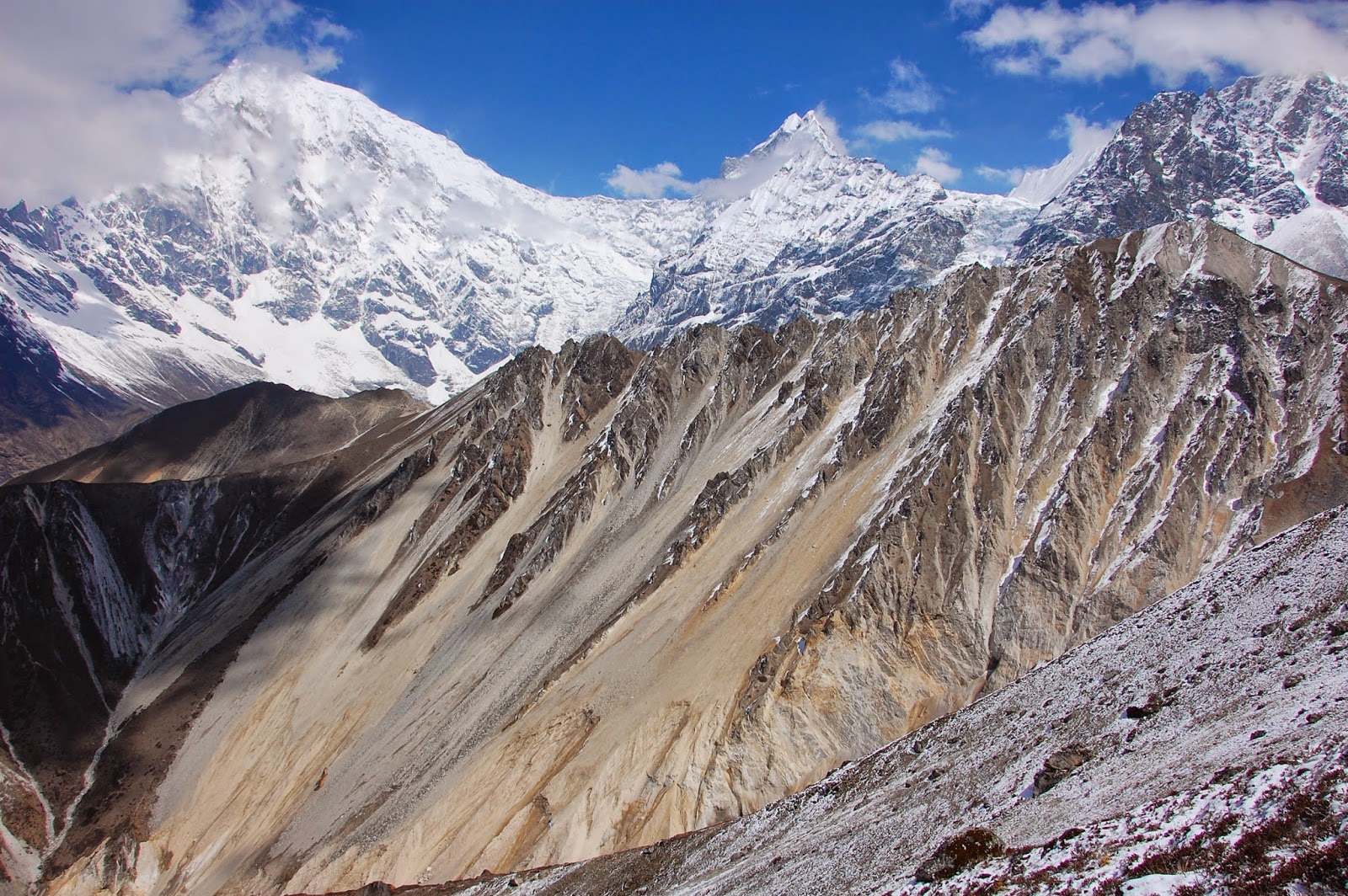
and the three hours of trekking that would take me from 3400 m to 3800 m were a rather large compensation of the previous night’s pessimistic conjecture: donkeys, porters, stupas and snow-capped mountains all came together in one big flood of Tibetan routine life and I took it in as much as possible while also gulping for the air that visibly grew thinner.


Upon arriving in Kyanjin Gompa – the outmost tourist settlement of Langtang valley –, and after finding a suitable guesthouse built, unexpectedly, out of brick and wood, I shocked everybody (including myself) and declared that I would climb Kyanjin Ri, the mountain that protectively watched over the little village. After all, that’s how it’s done, right? One always walks a little bit higher than their sleeping place to avoid the terrible headaches of altitude sickness, and, after all, it’s good practice. A beautiful afternoon awaited my panting and wheezing and my cussing myself for not taking with me either water or cigarettes, the two vital ingredients of my mountaineering life, which (I was about to find out) are a vital ingredient of mountaineering life and an almost deadly ingredient of said mountaineering life respectively. About the time my lungs had finally managed to get their message through, I was at 4450 m on Kyanjin Ri trying to stand straight confronted with vicious gusts of air.


The following day would be rest day. I decided that sleeping in would be the main attraction but life was in the way. Daily life. You see, Tibetans have this special way of communicating, understandable in the circumstances of great winds and even greater distances: they don’t really say anything; they shout it. They shout it LOUD AND CLEAR so that they’re sure their message has been properly received. And if all the conversations aren’t enough, the alluring morning sounds of gathering spit from the forgotten depths of throats and propelling them forcefully anywhere they reach… all this is truly enough to wake up even a hibernating bear. So ‘rest day’ became ‘reading day’, which in turn morphed into ‘glacier trek day’, which turned into ‘heavy menacing clouds gathering overhead’ day, which metamorphosed into ‘Tibetan bread and yak cheese lunch’ day, which reverted back to ‘reading day’ and finally ended in ‘having dinner and listening to Tibetans shouting’ day.

Next day’s plan was quite straightforward: wake up early (and, with any luck, avoid the Tibetan morning practice) and trek to Csargo Ri, a 4984 m high mountain, that would probably short-circuit my lungs but considerably inflate my ego. The only slight inconvenience was that it had snowed during the night. I was having second thoughts and compassion for my lungs. Also, as I only smoked very little, I started to contemplate another rest day with weak coffee and some cigarettes. But my ego got the better of me and I reluctantly started towards the mountain… only to find that I can’t find the way. Again my self-preservation instinct told me to stay away from such challenges but, alas, a Swiss couple came to the rescue and showed me the way. I was going up, sluggishly at first but then quite lethargic bordering on at all. And, when I came to a standstill, partly because I was pondering my option to shamefully turn around, but mostly because I could not see the path any more, the Swiss stopped being neutral and got involved:


The stars had chosen my path (with a little help from the Swiss couple, of course), so I went on. But somehow, it didn’t get any better, only if by ‘better’ you mean navigating through knee-deep snow and large boulders and, finally, crawling out of them with wet shoes and a mood that could curdle milk. But I was there and I had to somehow commit this historic event to memory so here’s a sample:


Impressed? Didn’t think so. Well, the photos might have turned out better if it weren’t for the fact that while falling and crawling through the aforementioned snow, my camera – strapped loosely around my neck like any self-respecting tourist would have it – shared my fate and got equally wet. But here are some pictures from before:


Sunday, 18 May 2014

First Time Nepal

Well, Kathmandu has just become my adoptive city and, as much as I can see, it is a fascinating place and a real experience, especially if you are fond of misleading touts and insistent sellers. And the very popular line of questioning 'you first time Nepal?', 'you like Nepali people?', 'you married...?'

The cold rainy evening that welcomed me once I stepped out of the plane was as inviting as a stomped toe in a place where silence is strongly reinforced. The room full of local people sticking their faces to the window in order to get a better view of the incoming crowds (also known as gullible tourists) was as reassuring as a bathtub full of sharks but, as I was positively sure, none were waiting for me.

I finally shared a supposedly free taxi to Thamel, the tourist hotspot in the city so it was no surprise in me also sharing a room with a quiet Dutch youth at the Paradise Hotel, where paradise would have packed up and run away as fast as a hunted deer.

The rain was persistent throughout the next day but that didn’t stop me from wandering through Thamel, the place where the tourists mingle mindlessly among tiny taxi cars and rickshaws while negotiating through some 1200 tour companies that bait their customers with shiny maps and internet photos of various treks in Nepal. This notwithstanding the numerous overpriced hotels and restaurants. But when a small battalion of policemen held hands in front of an alley with too many restaurants and bars, and the crowds thickened so that it would have taken a sensible natural disaster to make them disperse, I got completely confused; it turned out that the police had blocked the street and my enlightenment consisted in a really blurry mobile phone photo from an overly excited Nepali woman: an Indian film studio had taken control of the street to film a scene for their upcoming blockbuster. The film studio might more likely ring a bell as Bollywood. So when the director gracefully commanded ‘3, 2, 1, actiooon!’ and the main character appeared in all his glory a mere 50m away from the crowds, dozens of voices united in a clumsy but eardrum popping ‘hurray’ which was eagerly took up for the second and third take until finally the famous (yet, in light of these facts, not terribly bright) actor got everything right for the 10-minute shot.

Night-time Kathmandu is altogether another place than day-time Kathmandu. The sellers and dwellers retreat behind heavy, padlocked gates and out come the entertainers and their recipients: drunken, loud Kathmandu is what the place is called at night. Live music screams from most restaurants, as do the smoky voices of happy-but-not-really-sure-why-must-be-all-those-beers tourists. Guitars compete for the worst Pink Floyd or AC/DC cover but their audiences (Nepali and/or otherwise) appreciate every single note and even join the screeching speakers all around Thamel.

As luck would have it, my first Nepali bus ride only came on the third day in Nepal but I managed to find a reasonably long drive in order to fully appreciate this well-guarded and highly treasured experience. The bus was supposed to take us to the starting point of the Langtang trek some 120 km away and so it did, on winding roads up countless hills, never really driving downwards, but always cannoning passengers from left to right at every slight change of course. I still preserve the opinion that the bus ride was representative and my only argument is that it took about 8 hours and the music (be it Indian or Nepali – didn’t solve the mystery just yet) played the same tunes 3 times over. I can proudly declare that I am by now a fairly good connoisseur of some Nepali (or, maybe Indian) trendy music that’s been deeply engraved in my brain and can be accessed anytime one might fancy some tunes… Although the roads did constitute quite a challenge for the bus driver, it wasn’t all that long a drive: the countless checkpoints along the way, where tourists need show their trekking permits and where the odd Nepali officer has to neatly write down all the data while fashionably sticking his tongue out did, indeed, take a long time. Also, the lunch and brunch break were minor hindrances for the estimated travel time.


Lastly, I needed the reminder but will keep it in mind as long as I’m around here: there shall never be another day with fairly clean fingernails and a normal-sized tongue. The former is because of eating – usually done with the help of all right-handed fingers – while the latter concerns drinking – usually done to steaming-hot tea or coffee, meaning that my taste buds are in need of a long hospitalisation period, as they are no more than carbonized red blotches that dwell somewhere in the small confines of my mouth.

Sunday, 4 May 2014

Did You Know That...?

Well, as my travels through Myanmar have sadly (and abruptly) come to an end, here’s some fun, weird and simply jaw-dropping facts I’ve come to witness first hand.

For one thing, everybody wears a skirt. And I mean everybody! Hell, I probably looked like a deranged person for not having a longyi, which would have been the norm for both sexes. Even the gold leaf pounding guy had one while pounding away at thinning the gold leaf:


Motorcycle drivers across the country, government officials and beggars, kids, monks and nuns and, of course, women of all ages, all wear their traditional skirts. Look at these guys curiously ogling the ferryboat:


And how about this guy, carelessly rowing through the floating gardens of Inle?


Let’s just say it’s a really, well… airy country.

And the only other place where I’ve seen so many Children of Bodom t-shirts was a medium sized European hard rock festival. They just love that black, dangerous feel they get from those shirts, and the death metal t-shirt – longyi combination is simply a fashion statement.

The trip to the swimming pool was also illuminating. The murky bluish waters of the pool are as inviting as a crypt and the smell of fresh disinfectant might just turn you into a happily intoxicated zombie but once you plunge into its depths, you’ll find yourself at a loss on the proper direction of swimming. It would make sense to swim the length of the swimming pool but only if you weren’t in Myanmar. Here it’s common sense to swim the width of the swimming pool, about a third of its length and there are carefully marked lanes for that. But I repeat: you’d have to be in Myanmar to experience that.

The length is in front but do you see which way the kids look?
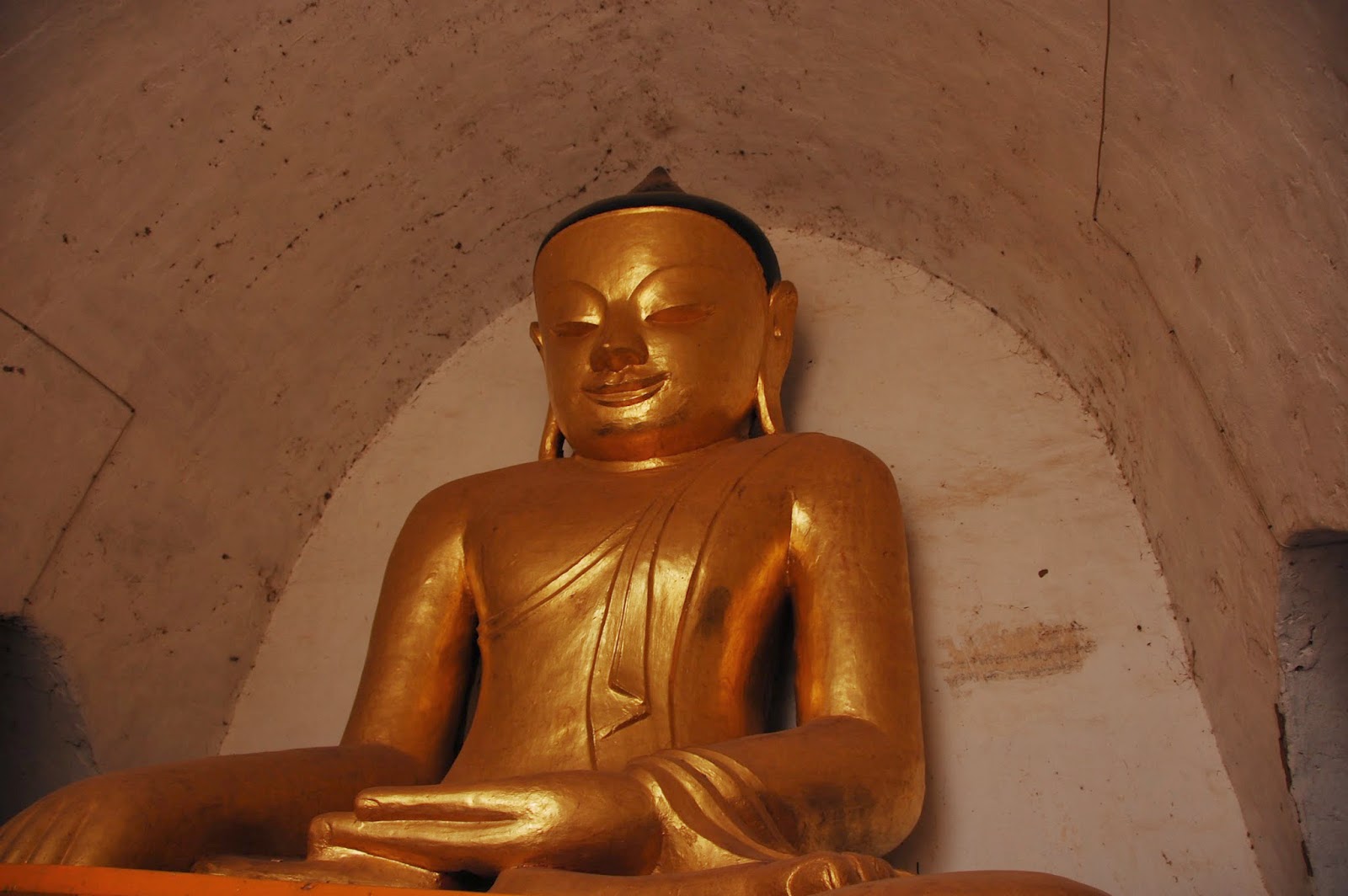
Lastly, there are the temples. Again. Because the temples are a big part of the country and so much orbits around them. Specifically, everything revolves around the Buddha statues. And, oddly enough, there are not many Buddhas that look alike. The images differ not only in appearance (surely because they have been fashioned according to their respective era) but also in expression, and so the serene, unattached yet benevolent Buddha can turn either into a puppet or into a clown. Just watch this:

Something-smells-funny Buddha

Robot Buddha

Surprised Buddha

Female Buddha

Tired old Buddha

Golden chunky Buddha, who gained over 2 tons of golden weight
from the gold leaf applied each day only by men

Sideways glancing Buddha. And driver.
 And my personal favorite:

Snot-nosed child Buddha
And if that’s not enough, just look at what other temple guardians they have:


The very last Burmese image that will stick to my mind dates from the airport in Mandalay, where, before boarding on the plane to Bangkok, I did a little exploring hoping to find a place to have a smoke. And following the ‘VIP Lounge’ sign, I stumbled upon this:


I couldn’t say if that’s the VIP Lounge but it’s definitely a smoking lounge tucked away at the back of the duty free shops, where Burmese life goes on as it has for centuries. And this is why I loved this country!

Friday, 2 May 2014

Why, Katha?

I left Hsipaw on a lonely bus towards Mandalay. I wasn’t feeling all that bad in the morning but, as soon as Mandalay’s hot and parching air hit me, I started feeling a little queasy. I would later learn that the fishy soup refused to be digested and was still slurring around in my stomach.

Mandalay is a big city. I haven’t seen it yet but even its map with its tidy network of streets looks intimidating. And, although I asked where in Mandalay the bus would stop, my question was eluded with ‘to main bus station 2000 kyat’. And, true enough, as I got off the bus, a gang of motorcycle taxi drivers charged at me. I fled and asked at a ticket counter where I could find a bus to take me to Katha. I was explained that I would have to go to one of the three main bus stations in the city and that I would be given a ride by a motorcycle taxi. The lady pointed to one and he rapidly led the way.

‘Wait’, I said. ‘How much?’
‘Bus station very far away, 11 km… 5000 kyat’, said the driver with the lopsided smile and hat respectively.

I only laughed and sat down to consult my 3-year old information from the guidebook while he quickly came to a 2000 kyat standard price. The guidebook said something about shared taxis that drive between the major bus stations and, although really crowded, are a better deal than anything else. I considered my options. I remembered that, worst case scenario, there was a train to Katha around 4 PM. So I looked for the shared taxis. Everywhere I went, private taxi drivers, whether on motorcycles or cars, tried to shove their services down my throat as I constantly said ‘shared taxi’. Their response: yes, taxi!

‘No, no! Shared taxi’, I retorted.

But every time they seemed to not understand what I said. After a while I suspected foul play and concluded that they didn’t want me to get a shared taxi. So I asked around some more. Finally, someone told me to wait for about 15 minutes and he’ll show me. I obediently sat down and waited but those 15 minutes! Sheesh! I forgot that minutes may differ in length and number in Asia, so it was no surprise that after a good half hour nothing showed up. I told the guy I was willing to go with a motorcycle taxi, he laughed and showed me a driver who could take me to the train station. That’s right, in the meantime, I decided I was going to take the safest bet and ride the train. The motorcycle taxi only cost me 2000 kyats.

I finally got to the train station all sweaty and lethargic and got a ticket for the 2:10 PM train. The afternoon one was already full. I would understand why some 13 hours later when I arrived in Naba, the place where I had to get off for another bus ride to Katha. The bus ride into town only took about an hour, which meant that by 4 PM I was sitting on a bench on the riverfront in Katha waiting for one of the assortment of available guesthouses to open so I can take a nap. I soon changed my mind and decided I would sleep on the bench, and so I did… for about 5 minutes until a guesthouse unlocked its doors.

Temptation was too strong: I asked for a room, got a 2x2 and instantly went to sleep. I woke up prepared to take it as it comes and, looking at the watch, I realized I still had 10 minutes to catch the boat further north. I went into Supertourist mode, packed fanatically, brushed my teeth and went out. But, as luck would have it, my passport was still at the guesthouse people awaiting a photocopy for their collection. Although I tried to explain that I really-really-really wanted to catch the boat, they told me to wait, made some phone calls and, smiling, went about their business. And, sure enough, as soon as I saw the boat leave the little port, the guy bearing my passport showed up on his motorbike beaming at me with a photocopy in hand.


So I ask you this: why, George Orwell? Why did you pick this godforsaken place as the stage of your book? Why is it that I can’t find even one of the buildings you described in your book? Why, George Orwell, why?

Thursday, 1 May 2014

Supertourist

I am proud to announce that I have been promoted to the ‘Supertourist’ status! And, if you were to ask what that is, I’d try to explain through examples of the Supertourist ways, which are above and beyond the normal tourist behaviour (there is no ‘ordinary Supertourist’, as Supertourists are, by definition out of the ordinary).

For instance, if given a train, Supertourist would gladly dangle over its sides while slowly being transported over Myanmar’s longest viaduct, the Gokteik Viaduct. Fortunately (or, maybe not), the train almost crawls over the viaduct because it appears that it creaks and contorts and is approaching its golden years even without the added stress put upon the structure by passing trains. But I’m glad to say no Supertourists found their end at the bottom of the Gokteik Gorges.

For Supertourist there’s nothing that’s not worth exploring. Even if Supertourist has only two short minutes at a train station, he will jump off and have a long look around: the new place might have something worth visiting so that any predetermined plan is completely useless. Hence, one more reason to travel light.

And how would Supertourist choose a guesthouse in any location? Would he use a guide book (like the ill-omened Lonely Planet) or follow the advice of other travellers? It would be a lot easier to have a quick stroll from the train station and look around for any prospective hot spot. Or, if the little flock of workers for a certain Yee Shin Guesthouse in Hsipaw would swarm around and thrust business cards in his face, Supertourist might just consider going there (especially since the 150 m ride is free). Even Supertourist might fall for your normal guesthouse owner/worker scheme: they say they have $5 rooms but first they show him the $6 rooms and if somehow Supertourist forgets to ask about the price, he’ll only find out once he checks out (incidentally, this is probably the first guesthouse in Myanmar where money is expected at the end rather than before checking in).

But Supertourist won’t mind. He’ll just make the best out of the remaining hours of daylight, rent a motorbike and drive around, exploring as much as possible. He would find the Shan Prince’s Palace, where a relative of the prince would sit him down and explain in great detail all the trouble the Shan Prince and his family have been through (and it’s quite annoying when you discover that Shan princes aren’t that rare, as there used to be 33 Shan states that required their own personal prince). Most probably, Supertourist will eventually faze out and nod whenever it is required but the majority of royal life details will be lost on him. He will then continue his adventure, finding the good sunset spot and hastily making his way there, only to find that the sun had already set and there’s not a lot to see as night falls rapidly over the valley. Still, there would still be some time to wonder through the little alleys on top of the hill, perched high on his motorbike, trying to copy the local ways by not getting off the motorbike without a serious obstacle in the way: temple gates or temple entries are not to be considered a serious obstacle. And, if questioned, he will invoke the ‘ignorant westerner’ argument, causing pitying or superior looks from locals.

Supertourist will take advantage of a new day from the early hours of the morning and, as soon as possible, he’ll ride around on the rented motorbike carrying a hand-drawn map of the surroundings and trying to find one of two waterfalls in the area, specifically, the one that’s not dried up. And, as success fails to show itself, as the non-English speaking locals will point him in the wrong direction, and as the roads become dirt tracks going steeply up a hill or another, Supertourist will stubbornly press on and will finally sneak a quick look at the secluded waterfall. The bike will be parked as close as possible, pictures will be taken and showers will be enjoyed.

But this will not be enough for Supertourist: he will want to know where the water is coming from, thus he’ll try to ride the bike up the hill, on a dangerously abrupt cattle path and through the crops on top, right up to the little farm suspended on the cliff above the waterfall. Having fulfilled his wish, he will have to descend on the same road with the bike, which will be the cause of some sweating and stress, soon to be forgotten by the approach of the Highway to Mandalay, from where new adventures start.

His aplomb will slightly fade when the bike’s chain will fall off the front sprocket and, being on the side of the highway with a tool-kit as useful as a fork for eating soup, he’ll have to flag down a nice Burmese mechanic who will not only reattach the chain but also tighten it as well. Spirit up again, Supertourist will start looking for a way towards the hot springs so lovingly portrayed at the guesthouse and, after a few failed attempts he’ll finally find a possible, if not probable way to get there. The overflowing river will never be able to dent Supertourist’s spirit: he’ll be up to the challenge and drive through the water as smoothly as a ballerina on a stage and reach a new and interesting sight: a stone quarry, where a dozen men are conveniently taking a break from crushing rocks with bamboo-shafted hammers and curiously eyeing the newcomer. Once he’ll ask about the hot springs, they’ll point to the river and indicate walking through it not far. But if Supertourist doesn’t fully trust walking barefooted through water on slippery rocks, the workers will soon explain that there is another way and will eventually guide Supertourist to the place. If the hot springs are still eluding Supertourist, he’ll accept the new-found spot, walk back through the river, watch how some huge slabs of stone almost come crushing down on his motorbike, and then drive to safety. He’ll soon arrive in the city, where he’ll try to find new hidden treasures.

Supertourist is not infallible though and needs sustenance. So, Supertourist must go out to find a restaurant for his special needs, for instance, a place that allegedly has vegetarian food. Upon ordering, he makes sure that the message is clear but once the food arrives and Supertourist has a bite, he’ll be struck by the distressing fishy taste of the broth where some noodles and veggies float and, being hungry after a full day, will ignore the fish soup and have noodles. As a consequence, Supertourist will be reminded of his fishy encounter the following day…


Supertourist’s day will end late, only to begin early the next morning, when the early Shan market must be visited before the 5.30 AM bus takes him away. Getting up at 4 AM is no problem for Supertourist: he’ll be lively and fresh, sprint around the market, have a nutritious rice breakfast and be ready to go by the time the bus arrives. Only after everything has been seen and done can Supertourist unwind and catch some sleep on the questionably comfortable bus seat. A new adventure awaits just outside the bus.

Wednesday, 30 April 2014

Kalaw Cross Country


This is Mr Robin. As we were about to find out, he was going to be our guide for the much-advertised trek from Kalaw to Inle Lake (Inle means Lake Little so Inle Lake would translate into Lake Little Lake, if you fancy exact academic names).

We were going to spend three days and two nights roaming across rolling hills and valleys and eventually get to Inle, some 50 km away. Mr Robin, our Sikh host in Kalaw said it would be a breeze eyeing my co-hikers, the three German teachers who signed up for the trek. He said his 20-something years of experience had taught him that German people are strong and fit and will not have any problems along the way. So were Polish people but they were too bad-tempered. Mr Robin never acknowledged the fact that I was to come along (and, hopefully keep up the pace). He didn’t have very much experience with Romanians and, most of the times, he was convinced that I come from Budapest or, sometimes, Bulgaria… surely it was something beginning with a B.

He did have strong political opinions, both about Myanmar and about the world in general: the Russian threat would prove to be an enemy to be reckoned with and soon it would overwhelm Europe like a furious parasite. His own country was something special, he said. I would never know what Myanmar was all about because most of the things the Lonely Planet was telling me were the exact opposite of what was really going on. No, it was not better that the country had opened up and no, tourism did not play a major role in the development of the country and no, I wasn’t right, I simply didn’t know what I was talking about.

All this he told me while waiting for the Germans to get ready. I still didn’t know he was going to be our guide so I felt confident that, once we leave this depressing person behind, the trek would turn out great. And when we figured that we would be guided by the 53 year-old Sikh, little buds of doubt bloomed into all our minds.

By the time we left the city, walking towards the freshly cut forest, Mr Robin had already explained the better part of Myanmar’s history and felt that his job was done for the moment. Accordingly, he bolted in front at the speed of a frightened deer, leaving us to wonder where all his energy came from. This little incident marked our whole trip: all of us lingered and lagged behind, feeling speed-challenged compared to Mr Robin. And in the rare moments he waited for us, he would explain a new and wonderful fact about the surrounding world, chuckling lightly at what he said: ‘There are 200 different species of banana in Myanmar. Most of them live in the area where tourists are not allowed…’

Most of the first day’s trekking was done on (or really close to) the railway tracks to Kalaw. We didn’t even realise that, after we had lunch at a small train station, we doubled back almost retracing our steps to the medicine man’s village, where Mr Robin had a wonderful time drinking tea and eating sweets offered by our host, while chatting with the old man about daily affairs. Did I say ‘medicine man’? Well, yes, that’s what he was. Mr Robin told us to ask any questions we might have but, as he started another politics discussion with us, the medicine grandpa fell asleep and nobody had the heart to wake him up.


Mr Robin’s knowledge about plants from Myanmar was, indeed, astounding: he would point out to something and explain its various medicinal uses with the confidence of a medicine man. ‘There are 50 ways to use this plant in Myanmar but most people have forgotten 40…’ If I had various types of diarrhoea or endless skin diseases, Mr Robin would surely have found at least 15 different types of plants to help me with my sickness. In fact, he was so interested in nature’s healing powers, that he became somewhat of a walking (running would be more accurate) botanical encyclopaedia of Myanmar. But, as he raced to our first accommodation along the way, he stopped caring about our botanical education. He had new and important discussions with our hosts as his last trek had been over one month before, so he had to catch up on the latest tribes’ news. That’s right, we stayed at a hills-people’s house, namely the Pa-O tribe, who offered each of us a nice blanket on the floor and a great outdoors shower without a door. But our cook (yes, we had one) came up with a wonderful dinner and we were quite satisfied. The evening ended with us 4 playing cards and me losing spectacularly at German card games.

The second day went pretty much along the same lines but the medicine man was substituted by a long well-deserved siesta after lunch. The only possible explanation is that we were so fast that, if we hadn’t taken an extra break, we would have arrived too early at our second homestay.


That night we tended to our newly-emerged blisters which would shame us more the next day, when Mr Robin frequently disappeared out of our sight. Fortunately, two of the four trekkers were up to the guide’s challenge, so that left me and the third German to mimic a hunt through Myanmar bush land for an unmistakable Mr Robin:

This is how I shall always remember Mr Robin

At noon we finally arrived at the lake, had lunch and navigated through stunning floating vegetable gardens and the mandatory jewellery-on-the-water-front store. Mr Robin had already left us with a ‘We will always try to remember you’, so typical for his personality that all of us hooted and watched him run away at the same speed he always employed, looking like he was on a mission to save Myanmar.

Bonus: here's some different ways to travel on Inle. Which would you choose?


Thursday, 24 April 2014

Burmese Birthday

Birthdays: they can be good or bad. Or both. But when they coincide with a national festival, they tend to be, well, let’s say special.

The Burmese New Year is celebrated sometime in April (depending on the phases of the moon) and is the longest national holiday in the country. Although the New Year is on the 17th, and the Water Festival lasts for 3 days before New Year’s Day, the official holiday starts on the 11th of April and ends on the 21st, leaving poor tourists who didn’t plan ahead stranded in various parts of the country: most busses stop working, are fully booked or are extremely expensive, some restaurants close their doors for the whole period, and common people go on holiday to the most touristic places, booking hotels in advance. I tell you, it’s hard to be a tourist on New Year’s in Myanmar!

But if you celebrate a somewhat special birthday during a Water Festival, things can’t go wrong (or dry). Let me explain: it’s called the ‘Water Festival’, because, as it’s mid-hot season and the rainy season is months away, Burmese people try to ‘invite’ water into their lives by splashing everybody with... water. Traditionally, it’s done by pouring a little water from a small bowl on the back of a person but who can stop the young generation? They have buckets, water guns and hoses begging to be used so that you’d think you’re in the middle of a biblical flood. Every person walking to and from anywhere will, at some point, find their way into a tidal wave of pouring, lukewarm water and will not escape dry. Tourists especially, who have to carry their passports, cameras and maps with them almost always will find that this tradition can be quite irritating, most of all when they discover that their precious belongings are soaking wet and their gadgets don’t work anymore.

I knew the drill: I was armed with plastic bags in and outside my own bag so that at least some of my stuff would remain dry. I also experienced with some futuristic movements whenever I saw people equipped with any sort of water containers and tried to hold my bag away from any incoming water, thus looking like a monkey trying to do a ballet while walking on fire. It almost worked. Unlike other people I met, my stuff was mostly dry, except for the maps and cigarettes (other people’s experiences tell me that a camera and/or a mobile phone will dry in about a day). Convenient as ever, the bulk of this game happened sometime during and after sunset. And what does one do at sunset in Bagan? One watches the sun set over the 2500 or so temples propped on some higher temple far away from the waterless hotel room which means absolution. And only after the sun has set and the pictures have been taken can one turn back to the hotel. And while doing so, one can’t possibly avoid all the Burmese gathered around a barrel full of water and a hose. Repeatedly. So, while returning from the temples on the electric bicycle I rented for the day, I tried to:
  • get the bag out of harm’s way with one hand while clutching the bike with the other hand (astronaut-monkey move);
  • not flinch too much and close my eyes for too long while water was thrown at me and I was driving;
  • keep the electric bicycle still working and not fall down.


So, after I successfully (though somewhat moist) returned the bike and returned to the hotel, I thought I should take the bull by its horns and go take some pictures. But then I thought that’s not the right way to celebrate a birthday or a national holiday so I did what any normal person would have done: I joined the crowds. I borrowed a bowl from the hotel, found a neatly arranged group of water barrels with satisfactory refill possibilities and started water-bombing everything in sight. Incidentally, the place I chose was set up by my hotel’s owner so, beside the water and the beers offered by said owner, we also had loud, loud, LOUD music to dance if we ever felt boredom approaching. We didn’t although everybody danced eventually. I also didn’t feel any dryness approaching for a long time.