Wednesday, 11 June 2014

Bardia National Park

He awoke from his rather short sleep and looked up. The fan was still working, which meant about another hour of electricity before the buzzing of the generators started invading Thakurdwara. It was 5:30 and he had to prepare for yet another day in the jungle. Tigers, he thought, they all wanted to see the tigers. And all had been fortunate enough to see them every day for the past month. He’d taken tourists into the jungle for 31 days straight and all came back satisfied.

Pardip was young but he was good at his job. He knew it. He’d been tramping around Bardia National Park for as long as he could remember and he could find his way anywhere with his eyes closed. Becoming a guide was only the rational thing to do. His mother had been so proud when he first told her he passed the exam; and he’d learned English too; and Hindi. If only he could have time to visit her more often…

He got up and nudged Krishna, who was sleeping next to him. They had shared the bed since the fire devoured his little bungalow. It had been two weeks before and, when he came back from the jungle, the lodge was filled with army people and villagers, watching helplessly how the flames consumed most of his belongings: the books, the binoculars and all the lodge’s documents were now ashes and dust. The Boss hadn’t been happy. The old copper wires and the heat had been too much for the mud-thatched little hut. But his guitar was still in one piece and most of his clothes. Ah, the clothes… he’d have to wash them as soon as possible but he never really had the time. Krishna had offered to wash them for him but Krishna was also busy in the kitchen.

He’d have to get up and see to the breakfast for the tourist. The cook might have forgotten about it and it was almost time to wake the tourist up. Then they’d head for the jungle.

…

The jungle: the sounds of countless birds, the familiar smell of leaves and elephant dung combined, the lush green trees, and the deer. He hoped to see his lucky deer that morning. It meant that they’d also see the tigers. But the deer were not in their usual spot. He didn’t worry much. He knew the rhino would probably be at its usual waterhole and that’d be a good start for the day. And, sure enough, he was there. It had only been an hour and the tourist was sweaty and slightly panting. And so was his new assistant. The Boss made him take the new guy and he was already complaining. He had to explain everything to him twice and he still couldn’t tell the birds apart by their chirrups, but his English was improving, which meant that soon enough Pardip wouldn’t have to translate everything to him.

He tried to get closer to the rhino but the rhino was quicker and disappeared into the forest. So they headed for the Supermarket: the best wildlife spotting place in the whole National Park, where any tourist, young or old, could get to without getting a heat stroke on the way. Spotted deer ran in front of them and monkeys jumped spitefully from tree to tree. But not his lucky deer. At the Supermarket others were already waiting but no tigers had crossed the river yet. They could wait for an hour or so and then move on.

It was easier than the day before: this tourist didn’t complain like the Israeli couple from the days before. They had been quite adamant about his language. He still wasn’t polite enough. He’d tried to be more tactful and delicate, and they hadn’t appreciated it. But they had sent him that great video with the tiger crossing the river, so all his efforts had paid off.

The tourist agreed to go all the way to the python’s lair and that meant walking through the thorny bushes and the arid riverbeds where those horribly loud treepies seemed to ridicule each human movement. Of course, the tourist had trouble with crossing the river: always getting the shoes off and back on, right under the sizzling sun. But Pardip was patient and he’d learned long ago that tourists wouldn’t be able to cross the river faster, even if he gave them his bamboo stick, even with all the rocks carefully placed so that every step would be easy. The sun was burning hotter now and all clothes were sticking to the skin like glue. But the big river was soon staring them in the face, its waters an invitingly grey sight. The water wasn’t big, just enough to cover a laid down body, but the cooling effect was all Pardip wished for. He’d surely keep a watch out for any wild animals but this part of the river was too exposed for any big animals. They were safe.

Pardip crossed the river in no time but the tourist took a long time negotiating the slippery rocks underfoot. On the other side, he walked barefooted to the trees by the riverbank and carefully crouched in front of the small lair. Yes, the python was inside, like always, and the tourist was gasping with surprise at the sight of a couple of coils buried in the dirt. Pardip had never had the courage to touch it; he’d always been afraid of snakes and he cheerfully admitted that, but he’d always hoped to find a strong, spirited tourist who could get the python out. Still, when beckoned to touch it, Pardip’s skin would prickle with disgust and anguish.

It’s always about the photos, he thought when the tourist flashed the camera deep into the burrow. All tourists snap shots to prove they’ve been places. And some get such nice photographs… The Indian photographer he’d guided through the park just some weeks before didn’t want to send him the pictures. They had been really good, Pardip was sure, but he also knew that to see them was to buy them.

He took the tourist back the same way he came and was as patient as before with all the tourist’s stops at the river crossings. He’d tried to help but the tourist was exactly like any other: stubborn, obstinate, self-absorbed, everything that was deemed abnormal in Pardip’s culture. He stopped for lunch under the protective shade of the big fig trees. He’d got a nice lunch today: vegetable rice and potato curry, a good nutritious meal. The cook had taken a liking to him and always had something put aside for him, especially if any tourists ordered meat and he had enough left over. He also suspected Krishna’s influence on the cook but he’d always made sure he’d show all of them the proper respect and regularly bought them whiskey and cigarettes. But only when the Boss wasn’t around; the Boss was a chain smoker but he didn’t approve of the boys’ smoking. They always had to hide for a quick puff from a cigarette that passed from hand to hand and was finished in seconds.

When lunch was done, Pardip showed the tourist back to the Supermarket and hoped against hope that a tiger would appear. They spent there some hours, the tourist reading and, eventually, falling asleep, and him talking away the minutes until they eventually made their way back to the lodge. But his day was far from over.

He went straight to the Boss and gave a complete update: the rhino, the deer, the python… no tigers. But the tourist seemed happy. Sure, tourists always seem happy, and never seemed to worry about tomorrow. Ah, tomorrow: it could be his day off. But right after the short shower, Krishna came in and told him about the Nepali people who’d come that day and wanted a jeep Safari the next one. There would be no day off again.

And then there was the tourist’s dinner and the evening’s preparations. The Boss always made him do it, even when he told guests he was a sort of manager; he’d still have to bring salt and pepper to the tables and fix all unpredictable problems. He was still the handy man. But today was easy: there was just this one tourist and the Nepalese people, whom were taken care of by the Boss. The Boss always discussed with the rich Nepali, and these were young doctors from Kathmandu, so he wasn’t needed.

His friends had invited him out for beers and, after everything was dealt with at the lodge, he went to the bar. Of course he’d have his cell phone close by, in case anything was needed of him. The night was quiet and dark, fireflies hovering around everywhere, competing with the myriad of stars in the sky. But then, the tourist came. He’d thought that the tourist would go straight to sleep, like most of them do after a whole day of walking in the jungle. But this tourist had something else in mind and, after some beers and some shared cigarettes, the tourist asked him if he’d be available the next day; it seemed that the tourist had changed his mind and wasn’t leaving Bardia yet. It suited Pardip just fine: he’d go with the tourist and the Boss would guide the Nepalese doctors. It meant a little more business, even now, when fewer tourists were showing up so far from the classic Kathmandu – Pokhara route. He’d just have to make some phone calls and explain matters to the Boss.

It turned out to be a good day, thought Pardip. He would share another beer and go get some sleep soon. Of course, he would have to get up early again and prepare everything for the next day: breakfast for the tourist, chores for the staff… But maybe he would see his lucky deer tomorrow.

Tuesday, 27 May 2014

Patience, Perseverance and Perspiration II

It was supposed to be a late monsoon and I was counting on it as I desperately wanted to see most of the country on the hard leathery back of my Hero, my Honda Hero. But monsoon was not as late as I hoped (or it was just a passing phase). And when that came, it was upon and underneath everybody at once: your inoffensive slight afternoon shower turned into a never-ending downpour with some hail thrown into the equation, which no umbrella could face it unturned: the rivers (a tiny trickle just a week ago) invaded the city of Tansen and took over the streets. That is to say the streets became rivers, which beautifully flowed downhill on the abrupt roads, yes, the same streets that just a few hours before had terrified me. Certainly, they still terrified me but not in the same way. Now, apart from the anguish of falling down on the ginormous incline or taking an unwilling passenger onto the front wheel, I also feared drowning said passenger on the way. Was this how monsoon season would be like? I had put my money on daily showers not unceasing baths in muddy red waters (which, by the look of it, seemed unpleasantly chilly).


The main activities in such weather are, by tradition, counting money or practicing the basic steps in becoming parents. Having small amounts of the former and no possibility for the latter, I resorted to other meanings Tansen could include: food, I conceived a plan to return to the guesthouse by entering all eateries so as not to get too wet but the master plan failed due to the lack of restaurants and available storage space (I started storing the food in the most obvious place, that is my stomach but its capacity soon came to an end). Bags I could carry but, thinking that having food usually involved consuming it at some point, I soon abandoned my plan and hatched another one: shopping, with its endless opportunities of getting useless junk just for the sheer weight of it. But this too soon came to a dead end, as most of my (as yet uncounted) money went on food.

It rained all night and I was getting tense, with a horrible itch to move out. And, come morning, so I did. Driving from Tansen to… let’s just say west, proved to be a whole day long business. I knew there were many uncomfortable kilometres to cover so I started early and put a considerable amount of effort into driving faster than my usual 50km/hour. So I drove (almost) 60! 70 on two occasions, a true performance, considering the continuous incoming (and outgoing) perils that surrounded me. Still, the early hours of the sunless morning were smoother than expected, as traffic was scarce and the weather was an impromptu shade of chilly, just until I hit the plain, some 40km later; the Terai plain, Nepal’s southern strip of land, where water could only be found by digging a well deeper than the length of a football field. As far as complaints go, none can really compare to the ones expressed by my, ahem, backside, an incredibly tender backside at the moment, what with trepidations from the bike, rocky roads and endlessly gruelling hours sitting in the saddle of the world’s most uncomfortable bike, always tilting and slipping in front, propping myself in the steed’s hump, which would be its bulky petrol tank. I really needed to stop a couple of times and, after too many hours of sitting, I desperately wanted to get up and find a nice shady coffee place, what with going through the whole singing repertoire of The Road, Draga Otee (my personal driving song), My Way and, remarkably enough, Matilda… well, that time, I finally managed to find a place in the Nepali scorching lowland, where no coffee was to be had (or, probably, known about), but lemon tea poured in such quantities that could quench the thirst of a herd of camels, and where one of the women in charge stroked my hair – surely her first encounter with dreadlocks – as if she was searching for a child to adopt. She liked me; I liked her and her gentle, if somewhat distressing caresses; we could not communicate one single word in a common language.

The next step was to get instructions and, mind you, there has been many a moment when I wondered if the instructions I got were right but I always pushed on and, sure enough, some kilometres later (usually around 40), the road proved to be the right one. As soon as I start driving towards [you name it], the first milestones and signposts stare blankly at me, whitewashed and clean. After said 40km I start making out distances on the milestones, usually in Nepali, which means that after a few more dozens of kilometres, I might spot an English sign.

This is why when I stopped in Kohalpur, a city with a major junction from where the roads could either take me to the Indian border or to Bardia National Park, the place where I wanted to stop for the night, I asked if I chose the road well. A confident, English speaking Nepali confirmed my choice and, after the usual 40km, I realized the Nepali (and me) had been wrong (and I was thinking that one of the perks of inquiring English speakers would considerably decrease the chances of misleading information). I was not heading towards Bardia, nor was I in India so I could only be lost. The mystery was easily solved when I glanced at my crappy Lonely Planet map and my eyes started watering: I had involuntary chosen the scenic route to my ultimate destination, Jumla. Why scenic? Because it looked as if the mountains had decided to move over just enough to leave a tiny passage for a minute road to insinuate into the cracks, all the while looking down on a riverbed with some actual water in it for a change. Pure poetry, if you disregard the exhaust from the trucks edging by. 


Scenic was also the wrestling match between busses, trucks and me fighting to get some wheels on the tarmac, with them winning by a nose (or tire, if you wish), pushing me benevolently off the narrow road.


I didn’t give in and, by late afternoon (as is my latest ritual), I arrived in Surkhet where I gave up the fight. The map proclaims that Surkhet has an airport, so I was expecting something more than just a road, a checkpoint, a gamut of busses, a handful of houses, and one (!) ‘Hotel and Lodge’. To my lack of surprise, the Hotel and Lodge was full but four sympathetic elderly Nepali men joined forces to put together an English phrase (totally incomprehensible) and pointed at another hotel, where I found a room. It would probably pass as a broom closet but it had the pride of the local tribe: an attached bathroom, a slightly smaller, damper broom closet.

Monday, 26 May 2014

Patience, Perseverance and Perspiration I

First stop outside Kathmandu: Bandipur. A small, smart hilltop town with picturesque buildings and a sleepy atmosphere, where locals refuse to rent out rooms because it would only cause them trouble with cleaning up and interacting with foreigners. It’s also a place where vehicles are not allowed.

Driving up hairpin bends on a road wide enough for a bus and a skateboard was fun, as it was late afternoon and no traffic. I stopped in front of the main gate of the town and realized that the little flight of steps thoroughly expressed the message that no motorised vehicle would get onto the main street. So I parked and, exhausted and sweaty (very possibly, actually dripping) went in search of a place to sleep. Time seemed to be forced back. People seemed to have emerged from long-forgotten times. The whole place seemed to have somehow come through a black hole out of medieval times. The only thing that gave the place a metaphorical slap in the face were the few tourists grinning stupidly and looking, well, like tourists.


But time is short so I decided I would leave the next day, not before going on a small trek to a remote village in the hills to see the so much advertised rural lifestyle. This is how I spent my morning hours the following day: sweating profusely and walking up and down a narrow path through the dry jungle (yes, I think there is such a thing), Namaste-ing small children passing me on their way to school. I busied myself with chasing insects and trying to capture some impressive images but all I succeeded was amateurish photos with tiny dots close to the centre, the type that need a convincing, complicated explanation: ‘see that little dot right next to the fifth big leaf on the right, yeah, that one that is not entirely focused…? Now that’s the bug I spotted!’ If you ask me, bugs should rule the world. And they probably do, only we’re too ignorant to realize that. But I did get the scare of my life, or, at least, of the last year or so; while walking exactly how I imagine Little Red Riding Hood capering friskily through the forest, something moved quite fast and grasped my attention by the throat: a shiny green snake decided it would be time to move and darted in front of me and into the shrubs without a glance back. I almost had a seizure and stood there like a statue, having trouble breathing. Come to think of it, I would not have moved a muscle even if the rather large snake (easily over a metre) had crawled in my direction. I wish I had taken a photograph but my clumsy immobile self was not capable of holding the camera for the next 30 minutes anyway.

The little village of Ramkot lacked any element of grandeur whatsoever


so I soon returned to Bandipur, all the way looking down on the path for something snakelike. But it was so hot that probably even the snakes went for a siesta.

No siesta for me though; I was on my way to Pokhara, where I would enjoy a couple of lazy days with music (too loud), swimming (too polluted) and a variety of foods (too many), but I’ll skip that for now and turn to the next stretch of my drive: the road towards Jumla. I still don’t quite know where it is (I haven’t got there yet), but I had a vague idea which way I was supposed to go and the first palpable stop on the way was Tansen, yet another small and sleepy village perched on a hilltop. This one, though, came with a bike access so I had no trouble prying all over the place, although at first I was prepared to set my Lonely Planet on fire:

Tansen, 119km south of Pokhara, is far enough off the radar to make a rewarding detour for independent travelers. Perched high above Kali Gandaki River on the road between Butwal and Pokhara, Tansen’s main attraction is both its Newari charm and distinct medieval feel. Lining Tansen’s steep cobblestone streets, which are too steep for cars, are wooden Nerari houses with intricately carved windows, from where the clacking of looms can be heard.

And that’s it. There are some other quite limited annotations but this is pretty much where the information stops. I was still meditating on the ‘too steep for cars’ part when I realized that Tansen is really quite vast and labyrinth-like and I couldn’t find the place I was looking for and my full-hearted question about the homestay went either ignored or completely disregarded. In short, it took me about an hour to find the guesthouse and in the meantime I also found the ‘too steep for cars’ part of the city: I experienced vertigo just by looking at the streets and I’m sure I’d have slipped while walking downwards and panted while climbing them. But I had to drive on them, which sort of looked like a hospital trip in the making. By the end of the hour I was starting to feel like being on an endless rollercoaster ride that’s going nowhere but I was judiciously guided towards the guesthouse by some nice restaurant owners (a place I would grow to love, as it would become the one I favoured).

I couldn’t leave Tansen without seeing Ranighat Durbar, Nepal’s Taj Mahal or so they say and, having the bike practically attached to my back side, I decided to follow Mr Man Mohan’s (the homestay’s owner) broad instructions and drive the 16 or so kilometres to there. It did seem odd that the trek would take 3 to 4 hours to the palace when the road only took, well, Mr Man Mohan did not really give any specifics, although he did say the road would be a dirt road. And I was surprised to find the first kilometres quite asphalted. But then…

Well, that’s the palace. And the road.


And that’s roughly how close I got to it. Let me explain: when you see a flight of steps in front of you, you’re prepared to walk up or down, depending on your position relative to the stairs. When you see a rock wall in front of you, you’re prepared to climb it with your bare hands (or, otherwise, turn around and run away). But when you see a mass of mountain ambiguously, misleadingly, maliciously disguised as a road, you’re sure to be in Nepal, close to Ranighat but not close enough to actually get there. The slopes are at an angle at which you’d sooner build buildings or rocket launchers and, once you passed the first couple and you’re still in one piece, the concept of Russian roulette comes to mind. When you still insist and end up in someone’s back yard (back drop to be precise), you weigh the situation and try to go back…


I managed not to fall down… more than once, which was not so bad, as some fresh bamboo trunks softened my fall. Getting the bike up and running uphill from an impossible position with the help on an elderly, really chatty old lady was the delicate part. I eventually found my way back to Tansen and thoroughly committed myself to getting lost again.

Friday, 23 May 2014

The Motorcycle Dairies

I don’t think it’s any news by now that I have a rather unhealthy fascination with motorcycles. And with dairy products. This is the post that acknowledges the merits of both items even though there’s really no connection between the two. I could tell you how fabulous it is to have an ample bite of cheese while riding a motorcycle but I haven’t tried it yet. Now, that I mentioned it…

Anyway…

Yak cheese in the mountains was a big part of my diet. And things didn’t change so much when I arrived back to the dusty civilisation of Kathmandu. If cheese is less available, there will be milk and milky products at every meal, even if the meal consists solely of milk coffee or, sometimes, when my brain fails to consult my culinary tastes, milk tea. There is no dairy-less day in my life.

On the other hand, there are the bikes. Motorbikes, of course. I wouldn’t be caught dead on a bicycle even if it represented my only means of salvation from a city on fire; I would prefer to walk and swelter to the rhythm of my ambulatory legs than to cycle around Nepal on dirt roads and under a baking sun. So I decided that motorbikes are the way to go. And, given that the opportunity arose not necessarily uninvited, I chose to look around Kathmandu for a bike to rent and take out to dinner for the next couple of weeks. I was rather overwhelmed by the multitude of choices for motorbike rentals which gave me quite a hard time deciding which one to pick and I went with the obvious decision: the biggest one available. Which was no bigger than 160cc but big enough for my personal goals.

Presenting the Honda Hero CBZ, currently my best friend
It meant I wouldn’t have to worry about bus stations and timetables, which suited me just fine and, having also received a very inflexible bungee cord to tie my bag with, I triumphantly jumped on and… stopped to look around. I was in the middle of Thamel, with motorcycles, bikes, rickshaws and people going about their business in all directions imaginable and my destination would simply be – with a stroke of luck – out of Kathmandu. So I sheepishly turned around and asked for directions (‘go straight and then turn left and then go until you’re out of the city’) and, having a vague idea about the general direction I had to go to, started driving for the first time in Nepal. The first ‘straight’ proved to be a series of small, tortuous alleys, the ‘turn left’ was a big junction where about three different very big roads went left, and the ‘go until’ was the rest of a city inhabited by about a million people.

It only took me about an hour to get to the outskirts of Kathmandu and only half as much to find a gas station that actually sold some petrol and, when I proudly declared I would like a full tank, the gas station people burst out laughing and told me it’s impossible and I could only get 500 rupees worth of fuel (that’s around 4 litres).

But it was enough to get me started and I pompously (and somewhat panicky) rolled up and down the first mountain and stumbled upon the first bit of Nepali road-engineering technology: half of the so-called Prithvy Highway did, indeed have some tarmac but the other half was just dust, rocks and gravel, strategically placed so that the people on the side (if there were any) would get an incessant vigorous laugh if their eyes were to meet a bouncy person and a springy bag on top of a bike that sprayed some brake fluid on the already sweaty, grimy driver. That would be me. Fortunately, there were no people around, so the only ones that got the best out of my appalling situation were the various truck drivers that curiously peeked out of their windows to get a better view of this intriguing apparition.


Twenty kilometres later, the road morphed into a beautifully winding way along a river and my reservations withdrew to mild anxiety attacks every time a truck, bus or car honked and came too close. I like to think of it as escaping death, let’s say, about 8 times, as vehicles from the opposite direction decided I represented no obstacle for their overtaking anything in their way while I was trying to steer my bike on the same road. So they basically drove me off the motorway and I behaved just like a frightened chicken each time. But it worked and my appointment with the heavenly world has been postponed. 

Thursday, 22 May 2014

The Downside

After all the uphill trekking and the scarce smoking, it was time to come back down. I was looking forward to some nice, less expensive meals and some cool, even hot nights; also, my clothes would need a good washing or even a nice ritual burning. This is why the next morning I packed really fast and then shuffled around the guesthouse and managed to get going at around 11.

I was already nursing a cold and a pretty strong headache, the miserable remains of a concealed, rather late altitude sickness, which didn’t really get to me in time for the actual climb of higher grounds and resolved itself to irritate me the moment it realised it must have been there before. It also refused to go away and, as I would come to find out, it stayed with me all the way to Kathmandu and after.

Going down proved a lot easier than going up and I had ambitious plans to go pretty far down the valley and reach the main town in two days, mainly because my money had dispersed really quickly and I would have preferred to look for the proverbial ATM in Syabru Besi, the one everybody talked about but nobody had actually seen. And, although I had some 5 to 6 hours of trekking, I took my time and stopped for tea, and then for yak curd and sea buckthorn juice, two of the many culinary wonders of Langtang valley, and, on the whole, I took it rather slowly, tripping over rocks as I gazed upwards watching yaks, horses, birds or the odd squirrel gracefully displaying only its backside. I reached my boiling point and refused to go any further than Woodland Guesthouse, a nice place that, I figured, would be halfway down the mountain, but I would later give in to the fact that it was closer to the top half than the lower half of the valley. As I prepared for yet another cold evening with my stuffy nose refusing to cooperate and making it hard for me to do the normal human thing and actually breathe, I was surprised to see that the weather had changed according to the lower altitude: no longer did I need to put all my measly possessions on myself, I could do with only half of the content of the backpack and it didn’t really matter which half, as everything had already acquired a certain odour that you get when you only pack two t-shirts and one blouse for a weeklong trek. I had already decided in Kathmandu that I would travel light, really light, and it was the best choice, as I saw from the envious looks of other trekkers that carried all their worldly possessions minus their grandmothers up and down the valley.

Still, I was impressed to find out that my aforementioned impossibly clogged nose was still able to pick up the incredibly strong bouquet of other hard-core trekkers and, whenever one would raise their hand to wave or point to something, a little part of me died… and then jump-started again because even the dead could be brought back to life with that particular garland of odour hanging around like persistent moths around a light bulb.

The Woodland woman was really nice and friendly and had a lot of fun without anyone’s assistance. She laughed and grinned all the time and, of course, seized every opportunity to shout something to someone. This last bit was usually done by the cordless phone propped almost in the middle of the trekking path, the only place for good reception:


The following day I flew down the mountain, although my kind of flight was more on the leisurely side, stopping to take photos every ten steps. And, if we’re on the ‘steps’ subject, just look at what the people around here did with the trekking path:


This is how most of the path looks like all the way to the top. That’s right, the locals put all the effort into building a gigantic stairway to the top because they reason that, if they have the stairway, they’ll all end up looking (and, regrettably, acting) like Rocky. Fortunately, the porters look nothing like Rocky, although their training might involve a lot more strenuous work…


When I finally arrived to Syabru Besi in the late hours of the afternoon, I was completely drenched and worn out, so the really lovely bucketful of hot water for a shower was the best present I could have received. Also, to my everlasting surprise the legend of the ATM turned out to be true!

Wednesday, 21 May 2014

The Langtang Trek

Walking. Hiking. Trekking. That’s what most people come to Nepal for. And that’s what I did for a vehicle-free, crowd-deficient week in the Langtang valley. The plan, as presented in Kathmandu, was as follows: one need to hire a guide and/or porter and/or guide come porter and let oneself be steered up the valley under the scrupulous eye of a very capable Nepali person who would explain in great English the beauties, customs and curiosities of the area. It would only cost anywhere between $500 and $1000. And, even if, say, the guide might have the same grasp of English as an Armenian puppy (which is not entirely unprecedented), one should never travel alone! One is at high risk of getting lost, missing or disappearing altogether, as some very convincing posters have shown. To be fair, this country has its substantial quirks, so it’s entirely possible (as I still suspect) that the missing people just wanted to stay missing for a bit longer than anybody would have expected them to.

They almost persuaded me to change my mind altogether and not go at all but, while attending a Couchsurfing meeting (every Monday at 6 PM at the Nepali Tapas Restaurant in Thamel!), I met a Spanish couple that was planning to go unaided through the auspicious Langtang valley. They carefully instructed me on how to get the trekking permit and, just like that, we scheduled a date for the following day to start our mountainous adventure, which inevitably started with – you guessed it – a bus ride. We arrived at our destination early enough to go through the sights, that is the main road and the houses and lodges surrounding it and, after a nice chat and a long-awaited dinner, we went to bed with that feeling you get once you know you’re going to start something spectacular in the following hours.

And start we did! From our guesthouse we passed our first bridge

this is not it but try to imagine one exactly the same placed in the middle of town
and stopped at the local Nepali German bakery for coffee and muffins.

It was supposed to be a three-to-four-day trek uphill to our future headquarters, Kyanjin Gompa, stopping every day in some little dwelling with lodges and hotels after about five hours of trekking. But, as these tourist abodes appeared along the way every hour or so, we took our time to stop for coffee and snacks. Once on a roll, I stubbornly went faster than my smoke-filled lungs would have enjoyed and left the Spaniards one lodge before, only to stop at a place with more trekkers than I would have imagined possible (the place looked fairly small so I had trouble visualizing all those people in not a lot of rooms but they eventually fit and my fright of having to share my room with somebody evaporated. I might as well have shared a room, as the damp plywood separating the tiny confines stopped the snores from tickling my ears as much as fish stop water – at all!).

With lungs protesting some more, I arrived the second evening in Langtang Village, the only place that is actually home to some of the 200 people living in the whole valley. As it was mentioned before, all the other places on the way have been lovingly erected keeping the trekkers’ comfort (but mostly their money) in mind. But I got a nice, cold cardboard box which passed for a room as a nocturnal shelter just as it started raining.


Enthusiasm dampened, I enjoyed the evening with the family and reluctantly left the warm kitchen with the warm iron cast stove strategically placed in the middle for my meagre four plywood walls for the night. I thought the good weather had eluded my trekking venture, that the end of the season had been marked by rainy days and icy nights, that the mountains thought about it and decided to be spiteful towards me, but the next morning only brought about good weather and weak coffee


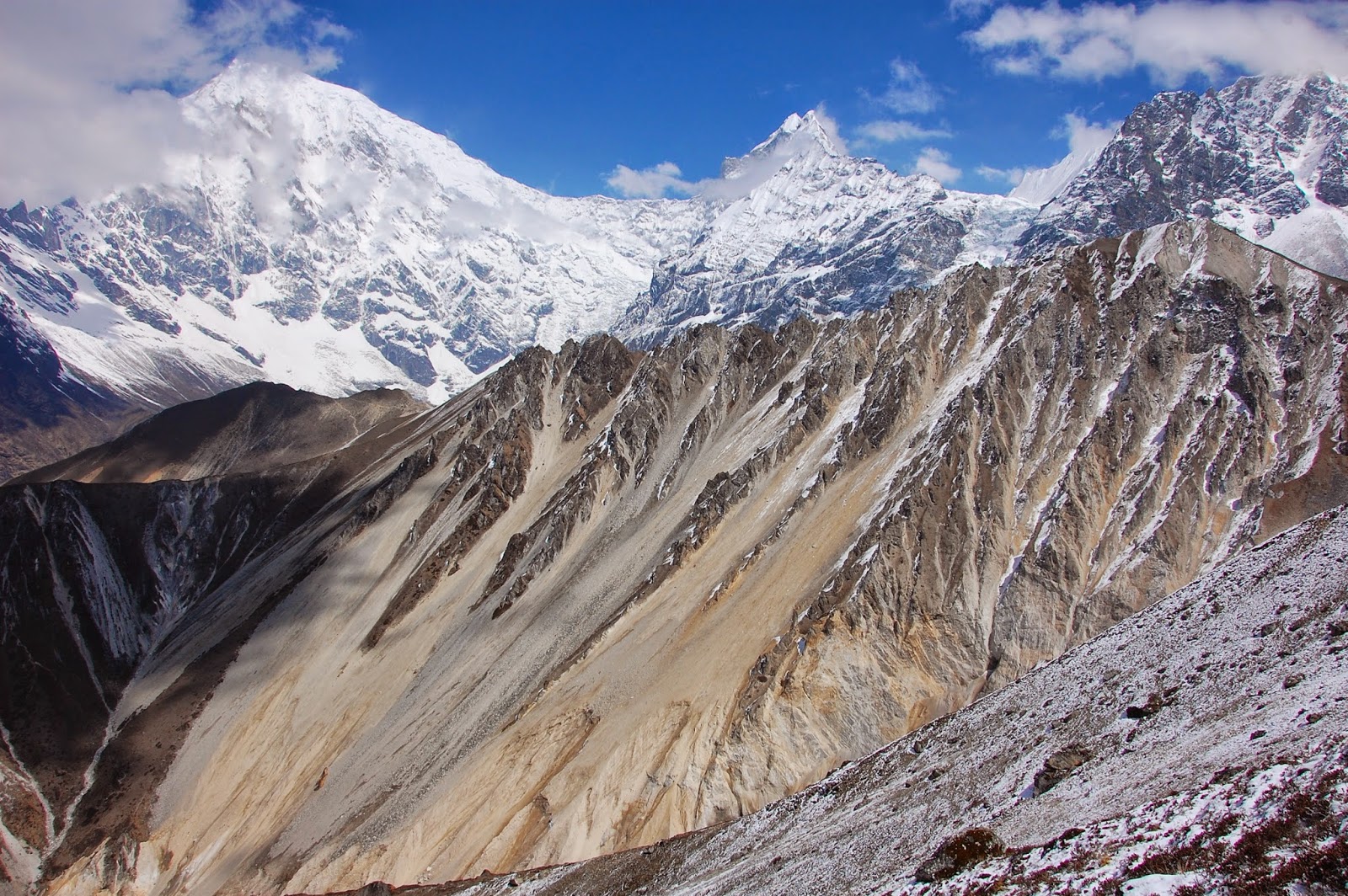
and the three hours of trekking that would take me from 3400 m to 3800 m were a rather large compensation of the previous night’s pessimistic conjecture: donkeys, porters, stupas and snow-capped mountains all came together in one big flood of Tibetan routine life and I took it in as much as possible while also gulping for the air that visibly grew thinner.


Upon arriving in Kyanjin Gompa – the outmost tourist settlement of Langtang valley –, and after finding a suitable guesthouse built, unexpectedly, out of brick and wood, I shocked everybody (including myself) and declared that I would climb Kyanjin Ri, the mountain that protectively watched over the little village. After all, that’s how it’s done, right? One always walks a little bit higher than their sleeping place to avoid the terrible headaches of altitude sickness, and, after all, it’s good practice. A beautiful afternoon awaited my panting and wheezing and my cussing myself for not taking with me either water or cigarettes, the two vital ingredients of my mountaineering life, which (I was about to find out) are a vital ingredient of mountaineering life and an almost deadly ingredient of said mountaineering life respectively. About the time my lungs had finally managed to get their message through, I was at 4450 m on Kyanjin Ri trying to stand straight confronted with vicious gusts of air.


The following day would be rest day. I decided that sleeping in would be the main attraction but life was in the way. Daily life. You see, Tibetans have this special way of communicating, understandable in the circumstances of great winds and even greater distances: they don’t really say anything; they shout it. They shout it LOUD AND CLEAR so that they’re sure their message has been properly received. And if all the conversations aren’t enough, the alluring morning sounds of gathering spit from the forgotten depths of throats and propelling them forcefully anywhere they reach… all this is truly enough to wake up even a hibernating bear. So ‘rest day’ became ‘reading day’, which in turn morphed into ‘glacier trek day’, which turned into ‘heavy menacing clouds gathering overhead’ day, which metamorphosed into ‘Tibetan bread and yak cheese lunch’ day, which reverted back to ‘reading day’ and finally ended in ‘having dinner and listening to Tibetans shouting’ day.

Next day’s plan was quite straightforward: wake up early (and, with any luck, avoid the Tibetan morning practice) and trek to Csargo Ri, a 4984 m high mountain, that would probably short-circuit my lungs but considerably inflate my ego. The only slight inconvenience was that it had snowed during the night. I was having second thoughts and compassion for my lungs. Also, as I only smoked very little, I started to contemplate another rest day with weak coffee and some cigarettes. But my ego got the better of me and I reluctantly started towards the mountain… only to find that I can’t find the way. Again my self-preservation instinct told me to stay away from such challenges but, alas, a Swiss couple came to the rescue and showed me the way. I was going up, sluggishly at first but then quite lethargic bordering on at all. And, when I came to a standstill, partly because I was pondering my option to shamefully turn around, but mostly because I could not see the path any more, the Swiss stopped being neutral and got involved:


The stars had chosen my path (with a little help from the Swiss couple, of course), so I went on. But somehow, it didn’t get any better, only if by ‘better’ you mean navigating through knee-deep snow and large boulders and, finally, crawling out of them with wet shoes and a mood that could curdle milk. But I was there and I had to somehow commit this historic event to memory so here’s a sample:


Impressed? Didn’t think so. Well, the photos might have turned out better if it weren’t for the fact that while falling and crawling through the aforementioned snow, my camera – strapped loosely around my neck like any self-respecting tourist would have it – shared my fate and got equally wet. But here are some pictures from before:


Sunday, 18 May 2014

First Time Nepal

Well, Kathmandu has just become my adoptive city and, as much as I can see, it is a fascinating place and a real experience, especially if you are fond of misleading touts and insistent sellers. And the very popular line of questioning 'you first time Nepal?', 'you like Nepali people?', 'you married...?'

The cold rainy evening that welcomed me once I stepped out of the plane was as inviting as a stomped toe in a place where silence is strongly reinforced. The room full of local people sticking their faces to the window in order to get a better view of the incoming crowds (also known as gullible tourists) was as reassuring as a bathtub full of sharks but, as I was positively sure, none were waiting for me.

I finally shared a supposedly free taxi to Thamel, the tourist hotspot in the city so it was no surprise in me also sharing a room with a quiet Dutch youth at the Paradise Hotel, where paradise would have packed up and run away as fast as a hunted deer.

The rain was persistent throughout the next day but that didn’t stop me from wandering through Thamel, the place where the tourists mingle mindlessly among tiny taxi cars and rickshaws while negotiating through some 1200 tour companies that bait their customers with shiny maps and internet photos of various treks in Nepal. This notwithstanding the numerous overpriced hotels and restaurants. But when a small battalion of policemen held hands in front of an alley with too many restaurants and bars, and the crowds thickened so that it would have taken a sensible natural disaster to make them disperse, I got completely confused; it turned out that the police had blocked the street and my enlightenment consisted in a really blurry mobile phone photo from an overly excited Nepali woman: an Indian film studio had taken control of the street to film a scene for their upcoming blockbuster. The film studio might more likely ring a bell as Bollywood. So when the director gracefully commanded ‘3, 2, 1, actiooon!’ and the main character appeared in all his glory a mere 50m away from the crowds, dozens of voices united in a clumsy but eardrum popping ‘hurray’ which was eagerly took up for the second and third take until finally the famous (yet, in light of these facts, not terribly bright) actor got everything right for the 10-minute shot.

Night-time Kathmandu is altogether another place than day-time Kathmandu. The sellers and dwellers retreat behind heavy, padlocked gates and out come the entertainers and their recipients: drunken, loud Kathmandu is what the place is called at night. Live music screams from most restaurants, as do the smoky voices of happy-but-not-really-sure-why-must-be-all-those-beers tourists. Guitars compete for the worst Pink Floyd or AC/DC cover but their audiences (Nepali and/or otherwise) appreciate every single note and even join the screeching speakers all around Thamel.

As luck would have it, my first Nepali bus ride only came on the third day in Nepal but I managed to find a reasonably long drive in order to fully appreciate this well-guarded and highly treasured experience. The bus was supposed to take us to the starting point of the Langtang trek some 120 km away and so it did, on winding roads up countless hills, never really driving downwards, but always cannoning passengers from left to right at every slight change of course. I still preserve the opinion that the bus ride was representative and my only argument is that it took about 8 hours and the music (be it Indian or Nepali – didn’t solve the mystery just yet) played the same tunes 3 times over. I can proudly declare that I am by now a fairly good connoisseur of some Nepali (or, maybe Indian) trendy music that’s been deeply engraved in my brain and can be accessed anytime one might fancy some tunes… Although the roads did constitute quite a challenge for the bus driver, it wasn’t all that long a drive: the countless checkpoints along the way, where tourists need show their trekking permits and where the odd Nepali officer has to neatly write down all the data while fashionably sticking his tongue out did, indeed, take a long time. Also, the lunch and brunch break were minor hindrances for the estimated travel time.


Lastly, I needed the reminder but will keep it in mind as long as I’m around here: there shall never be another day with fairly clean fingernails and a normal-sized tongue. The former is because of eating – usually done with the help of all right-handed fingers – while the latter concerns drinking – usually done to steaming-hot tea or coffee, meaning that my taste buds are in need of a long hospitalisation period, as they are no more than carbonized red blotches that dwell somewhere in the small confines of my mouth.