Wednesday, 28 November 2012

Lala Laos


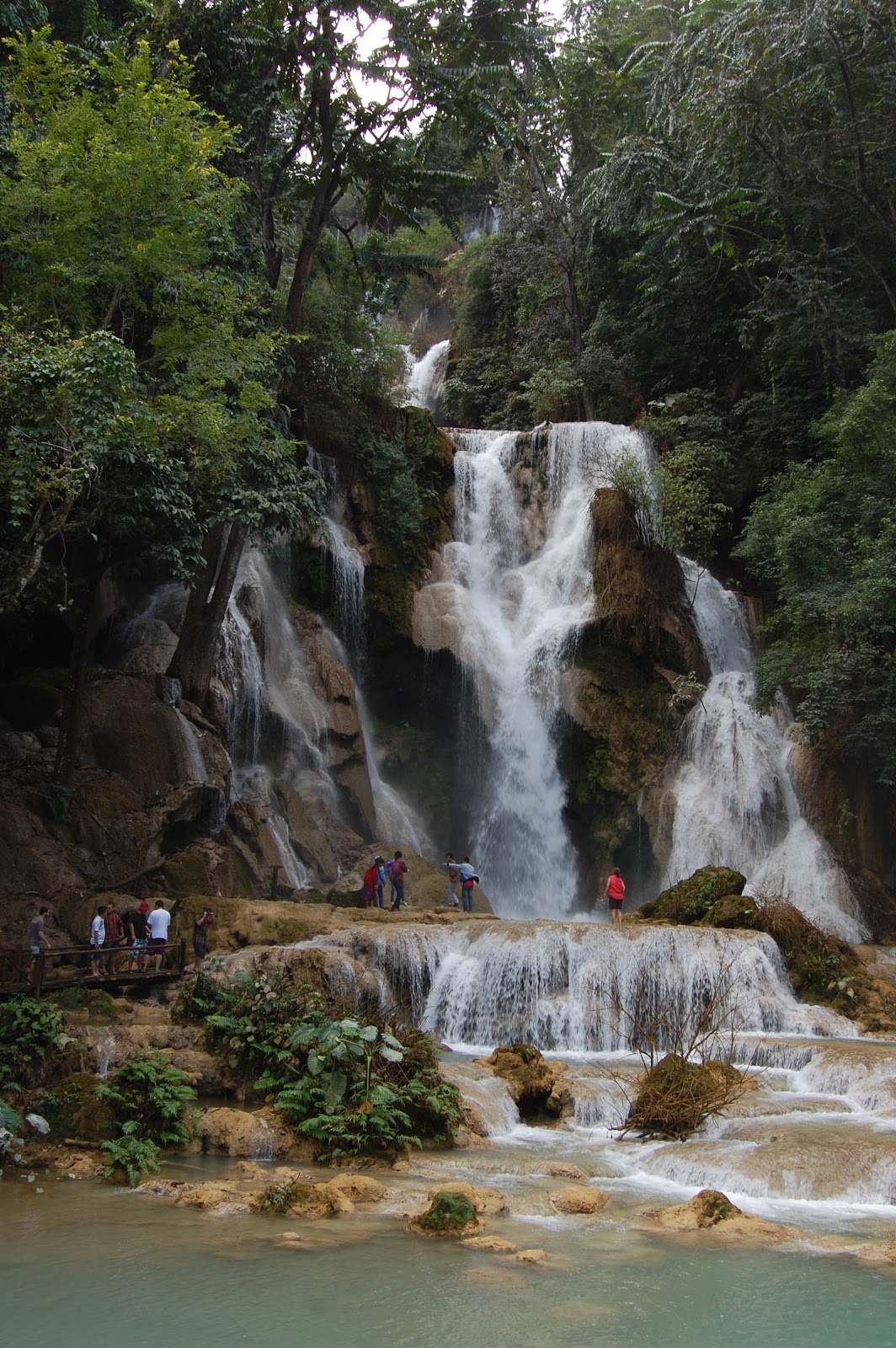
A friend of mine was very honest when he bluntly stated that he was a box-ticker, someone who just ticks the boxes of a ‘things to do’ list: tallest building, biggest Buddha, most laid-back country… you name it. So right now I’m also ticking a big box named Laos; a country where most places are simply described as ’sleepy’ and ‘relaxed’ and, as a French saying goes, while the Vietnamese plant the rice, the Cambodians watch it grow and the Lao listen to it grow. This translates into pure procrastination, refusing to engage in anything other than doing nothing and just being sleepy and relaxed. Yup, that’s the whole country! I haven’t seen that much of it yet but, being in one of the country’s most touristic place, I tend to believe everything I’ve heard. Also, I didn’t read much about Laos but, apart from some hidden, well-kept secrets, and treasures, there doesn't seem to be much to actively engage in.
But I like it. And the landscapes are more than words can say.
In a nutshell, I planned everything the wrong way, getting into Vientiane and immediately heading north, to Luang Prabang and now there’s the option of heading north or heading north. So, I’ll probably head north, although how far is anybody’s guess.
This is just a taste of Laos for now.


Sunday, 25 November 2012

Varanasi II

If I talk to much about Varanasi (or I remember some of its highlights) I'll probably become too depressed. It's not all bad but, for some reason, it was just interesting (not in the sense that you cannot be impolite and say it was terrible but you cannot lie as much as to say it's nice, no; in the sense that it was, actually, interesting) but always leaving me with a bad aftertaste. 
One of the days I went 10 km away to Sarnath, the place where Buddha held his first teaching in front of his first five disciples. The place is literally overpopulated with Buddhist temples, as people from all countries decided to build their own traditional type of Buddhist monastery. Therefore, you can have your choice as to which Buddhist temple you might like to see: could it be the Thai temple or the Burmese one? Maybe the Chinese or Sri Lankan or the Tibetan? Or simply visit all (if you have the willpower and patience) after you've visited the museum, the main stupa and the place where it's said that Buddha publicly talked for the first time. Yes, it's hard work and there's nothing else to do there anyway but it's everything Varanasi is not: quiet, small, fairly clean.
Also, they have a deer park, where you can see a lot of deer beyond the wire fences, which means that you'll basically see small pieces of deer through the meshwork. But you can also see this:


...which for me, was really something. I should have been more impressed by the magnificent, spiritually charged temples and sacred places, but what really got to me were the crocodiles!
Back to Varanasi, everything was back to Indian normality, even more so, as everybody prepared for Diwali, one of the biggest celebrations in India, a candle festival with lots of fireworks and firecrackers everywhere, so much so that you could effectively go deaf just by walking by the ghats. Cars, cycle rickshaws, auto rickshaws, bicycles, people... everything you'd possibly imagine were roaming the streets that day. So the only reasonable thing to do was to retreat at my usual cafe and finally have a hookah, sheesha, arghile, qalyān, or simply, a waterpipe. It was disappointingly light but still delicious. And then it all started!
Diwali is something like a Christmas Eve and New Year's Eve combined: it's a family affair, usually celebrated within the family, around a dinner table and some strong liquor after the normal temple prayers, but, at some point, the whole family will go outside and start lighting countless fireworks to the delight of everyone involved. And they will keep this up all night and the next day or simply as long as they still have a stash of fireworks left. The 'rockets' and 'bombs' are the teenagers' favorites, as they explode louder than anything else temporary disabling all animal presence on a radius of several kilometers (which, of course, means the monkeys as well, so there is an upside to this!). But first of all there's the candles, which you can see at every house and even in guesthouses. They even lit a small candle in front of my door, which was out by the time I got back. 
The cafe had its own little celebration, lighting candles in the form of the Ohm symbol, fussing around it for more than an hour and being overly pleased with the result.


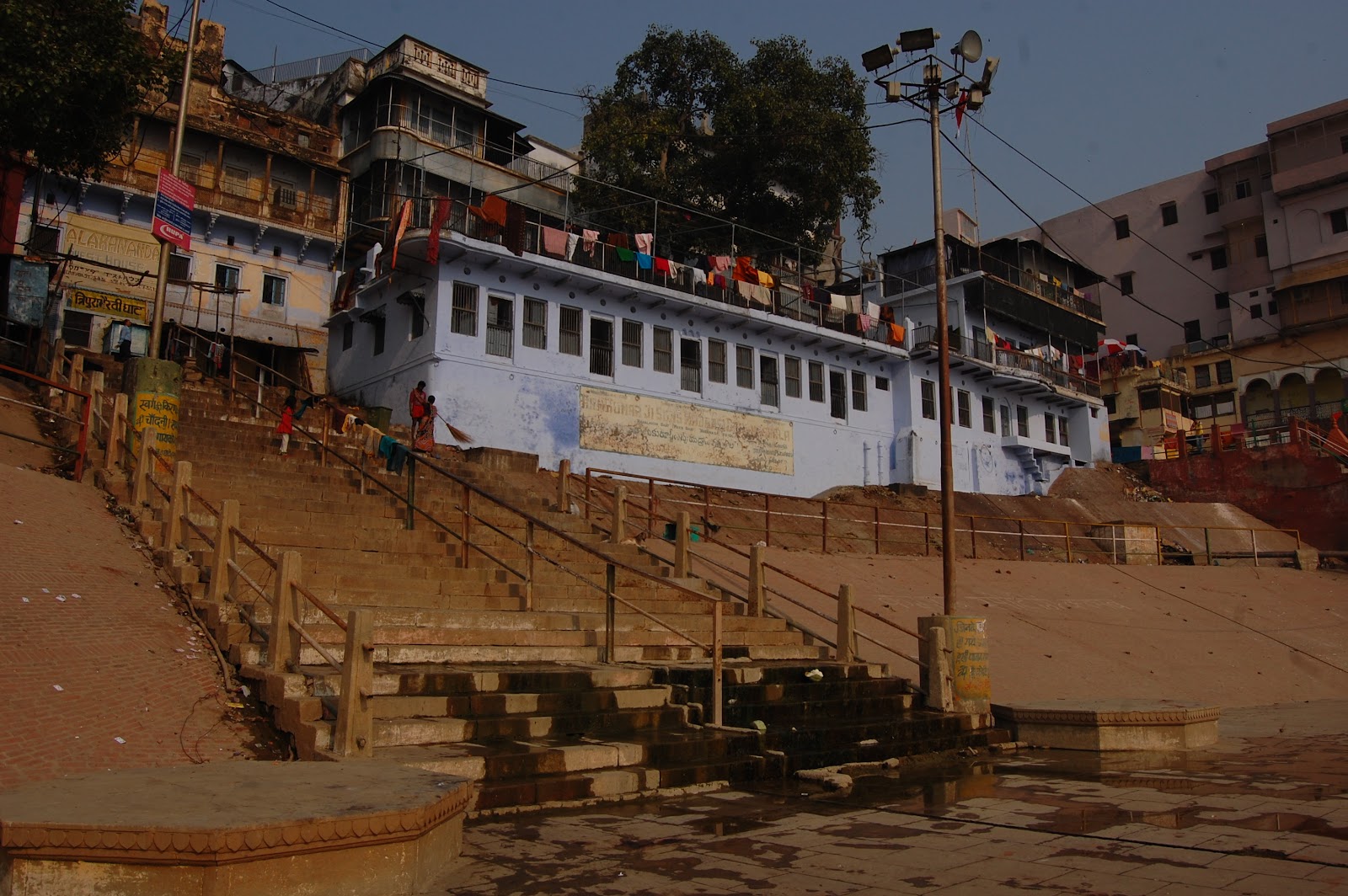
And then, this is Varanasi by day:


It was finally time to leave Varanasi and I was nothing less than happy to be heading out, although I was in for another overnight 12 hour train ride, which, incidentally, was also 3 hours late arriving in Kolkata. Well, all in all, 15 hours is not as bad as it might have been. Getting to Kolkata, I still had half a day to look around, which I much intended but the idea of moving around with my backpack was not at all that appealing. Still, I dragged the backpack with me at the only place that had been warmly recommended, namely the Victoria Memorial Hall, a massive, somewhat impressive museum where the biggest surprise was they had no cloak rooms or lockers whatsoever. Looking at exhibits with a 10 kilo backpack strapped onto your shoulders is entirely unpleasant, I can knowingly state! So I cut my visit short and headed for the airport.
Incredible (insane) India, we shall meet again!

Saturday, 24 November 2012

Varanasi


Do you know what 30 hours of riding a train on an upper bed with dozens of Indians scattered all around the floor around you and on all available spots, with children, bags, containers, food, cell phones and anything else imaginable feels like? Well, I don’t. because I slept most of the journey, enjoying my upper berth privacy and some iPhone music, trying to look friendly yet unapproachable (so as to discourage theft and communication respectively), but mostly succeeding to look sleepy and detached. The good part was that there were two nights of the journey, and Indian nights (implying sleep) start sometime around 8 PM, and the day in between somehow went by really fast. Were there any bad parts, you ask. Well, not counting the scarce meals, the bad bathrooms, the complicated way to move around and not stomp on some forgotten child or bag, and, by the end, the lack of water for the toilets and sinks, no there were no bad parts whatsoever. And, by the time I got to Varanasi, most was forgotten, as Varanasi itself presented me with too much to process.
New question: did you, by now, get the impression that India is a (very) dirty and (very) crowded place, somewhat primitive and underdeveloped? Well, that is all like slapping someone with a feather, compared to Varanasi.
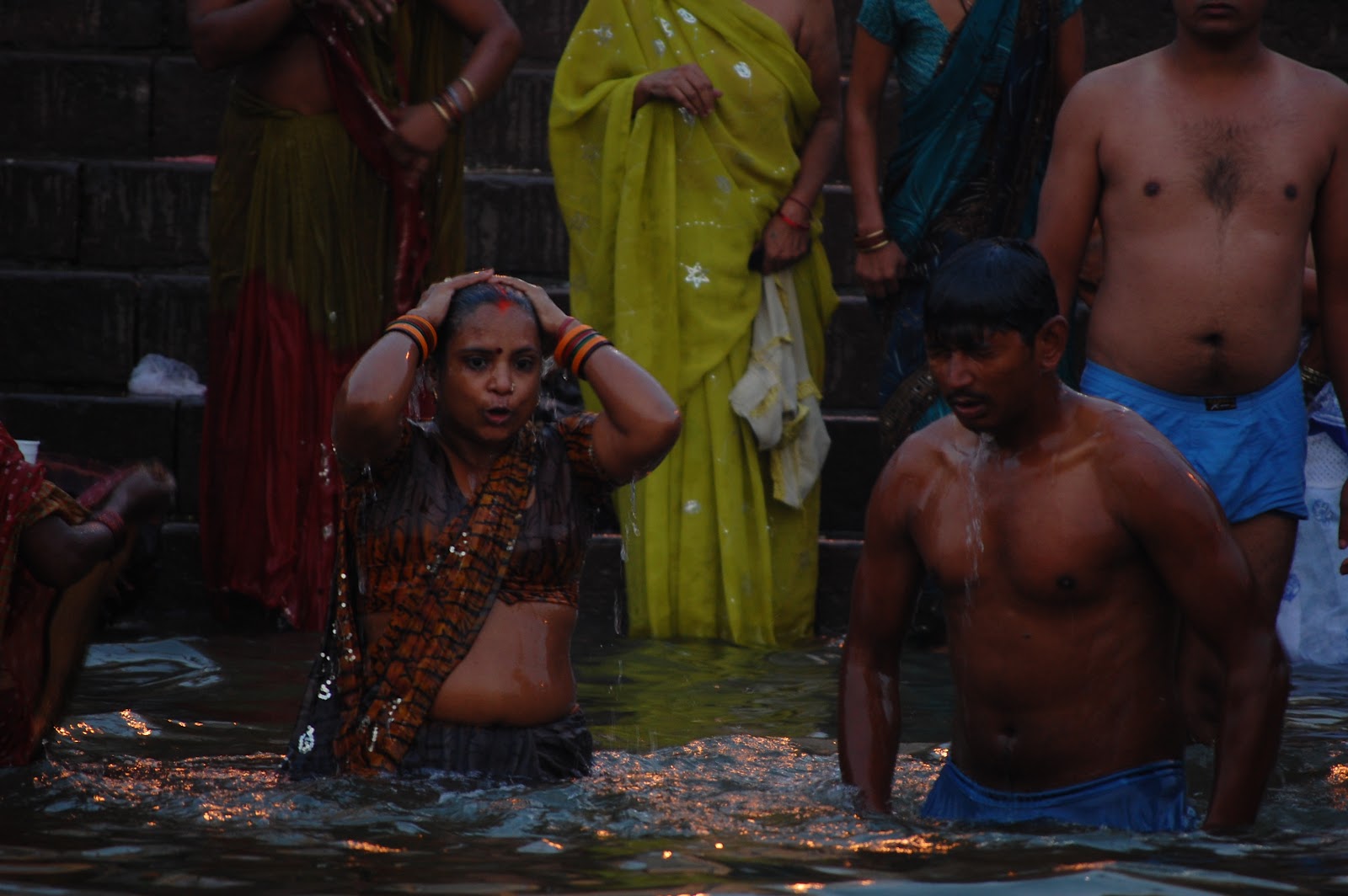
And did you think Indian habits, whether sacred or profane, were a tad ridiculous or destitute? Well, Varanasi takes that to a whole new level because it has an ace in its sleeve: the all-too holy Ganges River. Which, thanks to its sacred character, can wash away dirt, sins and cremation ashes, all in one flow.
I arrived in the morning and was persuaded by a fairly nice rickshaw driver to be taken to the city in some guesthouse, as I had no idea where to go (this was just after I had ripped my ‘Lonely Plan’ to pieces so I didn’t have to carry the whole book around and, even though I had my Varanasi pages with me, I stubbornly refused to use them). After three open-guesthouse views, I returned to option number one, a worn out dusty place, with very small rooms but with a nice view over the Ganges, even from my room, close to the Burning Ghat (keep this in mind for later). And, although it was not the best choice (guesthouse and city), I decided right then and there to give up my plans of visiting other cities and take a last night train to Kolkata to catch my flight out of India; four nights and almost six full days awaited my attention and a whole labyrinth of a city craved for my observance, which I reluctantly gave, because walking through the alleys of the old city feels just like I imagine a mouse must feel like while running in a man-made maze to get to the cheese. My cheeses were as follows: finding somebody to repair my totally destroyed bad rip-off Teva sandals; find a place to non-tourist priced cigarettes (I honestly can live without the extra 20% spontaneously added tax for a pack of smokes); and finding an internet café, preferably with both internet and coffee, which is quite rare on this side of the globe. Also on my list: escaping the labyrinth and somehow succeeding in returning to the guesthouse.
The first two quests went a lot smoother than I thought but the third one turned out to be simply impossible. Still, I was really happy when I stumbled upon a nice café in the yard of a temple, where the Nepalese waiter was friendly and the only annoyance were the monkeys, who noisily demanded food from the staff (which, obviously, obliged), and shamelessly refused to disperse (when the same staff threatened them at gunpoint, well, at toy-gunpoint which mostly made popping sounds).
And, at some point, I decided to find my way back to the guesthouse but was smart enough to choose the road by the river, past every ghat from the main one to the burning one. Thus, my first encounter with the Burning Ghat. Back home I live close to a cemetery so it wasn’t such a big shock to realize that by ‘burning ghat’ they simply mean cremating steps to the Ganges River, good old-fashioned incinerating; on a pyre; with wood; people covered in white shrouds; brought to the water on wooden stretchers carried by members of the family…
The ‘not taking pictures’ part I perfectly understand (although the reason is not as obvious as you might think; Hindus believe that photo cameras can trap their soul) but the total ban of wireless internet in the area because of something related to the cremations (again a not-being-robbed-of-your-soul kind of thing) is really out of my reach.
The ghat is working round the clock, as any dead body must be cremated within 24 hours of the death and it is a strong Hindu belief that dying in the holy city of Varanasi will spare them the fuss and trouble of reincarnating and they will get salvation. So, at any time of day or night, the Burning Ghat will be in full power, with bodies burning, holy men blessing and praying, families watching, wood dealers selling (it is said that they know the exact amount of wood needed to burn a body), people throwing ashes of burned out pyres into the river. There are categories of Hindus who are not incinerated: babies, pregnant women, sadhus (ascetic wondering monks), and lepers only have their lifeless bodies tied to rocks and are drowned in the river (as well as any dead animals) but – and this I say from personal experience – this is better not to be seen, as sometimes, the bodies get untied from their respective rocks and turn up floating on the river’s surface.
This much I found out while walking home that first night (well, this and the fact that all Varanasi Indians have weed and hash and good times for sale).
Of course, for 50 rupees, I did the early morning sunrise boat ride on the river, having a full hour to be wordlessly amazed by the life on the ghats. At every single ghat tens of Hindus gather to wash themselves or launch flowers and candles on the Ganges, or just pray in, with or next to the water. And all around, in boats or on land, tourists gather like sheep to see the city come to life. Indeed, it was as crowded on the river as on any normal Indian street but I realized that traffic jams on a river are worse than the ones on land, especially if you want to row upstream (I trust nobody imagined engine-propelled boats). Going back to the guesthouse was a lot easier (it was downstream from the main attraction area) and, being fully awake at 9 AM, I decided to go for a city tour with a 76 year old Indian who was supposed to show me around the temples of the old city. At 10.30 he came and took me around, being very helpful, in a taciturn kind of way, but showing me a lot of small, old temples with the inside story as well.


The daily evening celebration at the main ghat is something you must see at least once, although it is not so special once you’ve seen it. It does take place every day and there are innumerable people coming to see the celebrations but, for a westerner, it’s just some guys waving dust mops all over the place.


Friday, 23 November 2012

Diu Days


You don’t have to be a genius to figure out that companies who sell full packages to tourists cut corners and search for cheap deals in order to grab and hold on to as much money as possible. And ‘Diamond Tours’ is nowhere near of being an exception: our last tick on the boxed sheet of Rajasthan was a train ride from Udaipur to Ahmedabad and that much closer to the seaside. We were planning to visit A’bad for at least half a day and then take a night bus to Diu, a northern beach resort.
As it were, the corner cut by ‘Diamond Tours’ was exactly this train: it would take us 11 hours for a mere 400 km, which not even by Indian standards is really acceptable. So we pushed hard to have it changed for a more bearable 7 hours by bus, which only led to us not having time to see much of A’bad, except for the bus station and even that in the dark (but that’s always better than seeing it by day). Still, it gave us (mostly Mona) a better insight into ‘The Indian Way’, more specifically, the Indian way of bus riding. This, compared to the 4 hours of waiting and the night semi-sleeper bus that humped its way to Diu, was virtually nothing! I am starting to think that the Indian roads are part of a conspiracy to ruin people’s peace of mind and sleep, as they are usually paved once the bus ride starts, which gives you a feeling of safety, but, as soon as you think all’s going to be, literally, a smooth ride, the roads become like mosquito bites on your back: you cannot see them, yet you know they’re there because they’re irritating and inconvenient as hell.
History is repeating itself and, while I had a somewhat uncomfortable, restless sleep, Mona was up most of the night and by morning, she was looking more like a scared owl, eyes big and red and a mood to match. But we were at the seaside and were looking forward to three days of not packing, not reorganizing backpacks and not checking out. It would be heaven, if only we’d find a nice place to stay with some sand and water somewhere less than 50 meters away... So we took the advice of the blaze information officer, who wearily suggested Nagoa beach, the best beach area in Diu. We did what he said and we found the Richie Rich Resort, a place ‘for rich and famous’, so, being both (to what degree is up for discussion), we happily checked in and started the routine which would keep us going for a while: sleeping, eating and drinking, sometimes in a well established order, sometimes all together, sometimes on the beach, sometimes in the safety of our mold-scented fanned room.


This being India, nothing is quite this straightforward; having a strip of sand full of Jet Ski riding eager Indians and as many old white people as you could count on the fingers of an old hand, swimming inconspicuously as a young white woman in a swimsuit on top of all, is not ever going to become a reality. A swimsuit could describe most outfits universally accepted except for the half meter fabric that covers about 20% of your body, not even reaching the sexually intriguing (for Indians) neck and shoulder area. Now that’s definitely no suit!
Back to the matter at hand, it was impossible to avoid all the curious Indians intently watching us going in the water but we ignored them as much as possible and did our job. During the first two days we went as far from our room as the length of a football field, eating, drinking and sleeping our way through the tourist-less resort. The biggest decision we made was going in Diu Town for dinner on our second night, as we’ve read in our priceless guidebooks that there’s a place that serves barbecues in the evening, so our chances to meet fellow tourists would increase by 100%. Also, the place would supposedly be an old church turned guesthouse. The matter of serving barbecue ‘every other day’ had not been made clear enough, so we figured it out once we got there: the party would be held the other night, as in the next one. Nevertheless, we asked to see a room because we might consider swapping our eating-drinking-sleeping headquarters for the last night. And we instantly agreed to get the room, even paid in advance to do so. What could be more awesome than spending a night in a church and not being forced to do so (or go to mass)? Well, this was not your ordinary working church, as the actual church room had been converted into a museum and, obviously, the later added quarters of priests and monks had been turned into paying guests’ rooms but it still looked (and felt) as the ex Portuguese colonists’ catholic church.


We happily checked in the next morning (although our plans of not packing/unpacking for three whole days had been ruined) and, after exerting our well established routine some more, we split into one-person teams, one heading for the beach, the other to the train ticketing office. My team, the train ticket one, of course, was pissing its pants (to put it lightly) because it might not find a train ticket from A’bad to Varanasi, one of the last Indian stops, as the big holiday of Divali was approaching fast and tons of Indians were also heading that way.
If I have not been ranting enough about trains and the great train system of the country of Gandhi, you should just know this: when an Indian desk clerk sees in his database a waiting list of roughly 550 people for the train you just asked a ticket for, he’ll start laughing in your face. Hard. And the only option, which, surprisingly, has priority over the waiting list, is the emergency 24 hours before departure Tatkal system, which is simply described as ‘first come, first serve’. As I had 2 days until this epic train ride D-day, I resolved to come back the next day, 10 AM sharp, stay in line, cross my fingers and hope. So my team headed for the beach but not before immortalizing this:

Words are useless...
Meanwhile, the beach team (comprised of Mona) was just beaching away, happily sunbathing but impossibly getting into the water higher than an unsatisfactory ankle level. The reason, as I witnessed myself, was a huge slab of rock standing between the beach and the swimmable water, so deep that you could walk on it (and on the funny-looking creatures and live oysters that made the slab their home), but so strategically placed that if you’d jump off it into the water, you’d be propelled in it by the waves. So we gave up swimming for the day and, after some hours of sunbathing headed back to the church guesthouse (church-house?) to grab some barbecue along with other English speaking people – and I mean English not Hinglish. The closest we got was German English and Israeli English but we eagerly settled for that and joyfully went to sleep in the house of God.
I’m sure that sleeping in the church-house would have been a far better experience were it not for the early morning wake up and the trip to the train reservation office. Being the only white person there and also the only woman there, the system abided by the rule of ‘not first come, second served’ which meant that my ticket was issued at 10.04 AM: 30 hours A’bad – Varanasi, a happy occasion, a reason to celebrate with some beach-hunting, this time preferably with swimmable coastline. And it wasn’t even as far from the place of our first attempt: smooth, very fine and very hot sand, water to spare, pleasant and clear, inexistent human beings, except for the odd Indian ogler… it was a good end to our seaside complete relaxation holiday. We got to the bus station fully prepared for another bus ride, this time investing in a sleeper bus and, with less frets and pain, we came into A’bad at 6 AM, confused but somewhat rested (even Mona).
A’bad surprised us with really beautiful sights, which we decided to see before a self-imposed limit at 2 PM, when Mona would head for the airport to catch her flight to Delhi and I would get another 5 hours to mentally prepare for ‘The Big One’, the train ride crowned ‘My Longest Ride in India’. The mosque, the temple and the city’s gate we saw were exceptionally pleasant, as were the animals encountered on the way.


Last but not least, there was the museum, because of which I finally understood the curse Le Corbusier had cast on modern architecture. It seems he really liked concrete and to experiment with it and was commissioned to design many buildings in India, not to mention an entire city. But, as experimenting goes, it opened the road to concrete cities, from where the crappy apartment blocks got their inspiration.


Finally it was time to part ways with Mona and we said our goodbyes but I refuse to describe the feelings stirred inside me by our separation. Let’s just say that my sadness could even reach the ionosphere.

Tuesday, 20 November 2012

Pur - Part III


Leaving Pushkar: check. Driving to Jodhpur: check. Which was probably the highlight of our Rajasthan odyssey.
First of all, the hotel we stayed in was something else, with a room the size of a storehouse and two double beds to match. When we chose the budget hotels and our big-chaired guy told us we wouldn’t be disappointed, I had my doubts, especially about the hotels. I had been staying at places that not even bedbugs would have wanted to be seen at, and I was halfway imagining that the ‘budget hotels’ would be something like the last bomb shelters in a Syrian village, but the truth was that there were pretty good places to stay at. Some even had hot water! Some had complementary shower gels and body lotions. But this one was, by far, the nicest one:


And in the morning, our journey started in the city’s fort, one of the most beautiful forts I’ve seen in India. Not just the fort, its different areas for different maharajas and royal wives, the very colorful rooms and simple, yet majestic inner yards, but also the view from the fort’s defense walls over the blue houses sheltered at its sides made us act like judges in a beauty pageant and decide in favor of Jodhpur, the grand winner, Miss Indian City.


Anil took us to some other must-see attractions and then, because he knew from the ‘Lonely Plan’ that it had been chosen a favorite eating spot, he took us to the 'Omlette Shop', a small stall in the heart of the old city of Jodhpur, where we ate an interesting – quite good – omelet from the guy that cooks omelets for the last twenty years. Of course, the first thing he asked us was where we were from (no surprise there), but he did impress us when he came with the food:

Notice the plate...
Score: Ciuc 1 - Ursus 0!
Well, we couldn’t let a day go by without having some frowning stares directed at us, so we decided to have a nice night out on a fancy rooftop for the sake of the view of Jodhpur and the fort at night, so we forced our way into a restaurant with, indeed, a lovely view of the surroundings. Well, the staff wasn’t exactly what you would call ‘friendly’ but they served us anyway, on the condition that we had to evacuate the place as soon as the guests for which the table was reserved arrived. But before doing so, they had us move to another table and dispatched us back and forth until we had enough and vacated the premises.


We really would have loved to stay more and look around the next day, but Anil was intent on driving early to Mount Abu, so we didn’t have any choice but wake up and leave the next at an Indian 8 AM (which, of course, is more like 9 - 9.30 AM). We stopped on the way to eat something on the side of the road and Anil was pretty relaxed when he told us that he had paid 380 rupees for the meal for the 3 of us. It doesn’t sound quite probable, as the place was just like any other place with unidentified animals running around through the kitchen (or what doubles as a kitchen when it’s not just the place to hang around or hunt for meals). We arrived in Mount Abu by a good, winding road, which made Anil happy about ‘mountain driving’, behaving more like a race car driver on a test drive, but we kept our ground (and our stomach content) and made straight for the Jain temples.
The beauty contest judges must again decide: the winner is definitely this Dilwara temple complex, with a bleak Taj Mahal as a runner up. And, although it’s free, you cannot take any pictures and they’re right, because you could spend a whole day just taking pictures of details of the three main temples or of the smaller structures. But, obviously, one hour was not enough for us at the temples and we made up our minds to come back the next day.
Anil had the major responsibility of finding a good hotel for us, so we searched some time for a decent place to stay. He eventually found something suitable and proudly showed us a double bed room in a newly built hotel, quite dingy and faded but tolerable enough. He was very much interested about our reaction, as it had probably been the first time when he had the duty and honor of choosing a room and was especially excited about the mattress’s fitness. Well, we slept well enough and in the morning we slowly walked around Mount Abu’s lake, climbing up steps to the ‘Toad Rock’, which overlooks the lake and part of the city. Going down was trickier, because we took the advice of some young Indian high school students, who, after helping their selves from my cigarettes, pointed over the edge of the rock and told us we could walk down that way. And we eventually did, after creeping through some bushes to find the path, dodging monkeys that watched us suspiciously and avoiding card playing Indians that also hid in the bushes.

Another Indian mystery: the yellow line could indicate the path (which is not easily found,
even with the line) or it could just mean the end of the safe area...
Toad Rock
And to the temples we returned. Armed with pens and paper, to sketch some details from whichever part was in front of us, because any part would do, we sat down in a far corner of  the temple's yard and started drawing. But our harmonious creative time came to a sudden end when a group of Indians flocked over to see what we were doing. Thus drawing became quite impossible because usually when you want to sketch something, it is a lot easier to actually see your model than to look up at thirty-eight smiling Indian faces who, on top of wanting to see what it is you’re drawing, will want to shake your hand as well. I chickened out and ran away from them but poor Mona had to shake everybody’s hand while showing them her work. And even so, our art session was cut short by a temple guard, who probably came to see why all the visitors stopped in a corner of the inner yard; confused about what he was supposed to do, he chased us out of the temple.

‘What do you mean? Aren’t we allowed to draw?’

He just shook his head and pointed to the exit. We understood. We had been kicked out. Even so, we went to another temple, not as beautiful but less visited, where we hastily made some sketches to avoid the guards as well as the crowds.
Back in the car, we headed towards our last stop of the special tour with the private car, Udaipur, where we got yet another (pretty nice) hotel with yet another cool rooftop view of the local palace. We walked around in the morning, looking at a temple with karma sutra carvings and then a hill with paintings of great maharajas and warriors, from which this is one of the greatest:


Yes, that’s right. The guy doesn’t have a hand or an eye, which he lost in some war, yet he’s still one of Udaipur’s best! Unfortunately, the guards at this particular gallery did not really appreciate my laughing like mad when I saw the painting.
We then prepared for the palace, the biggest of all we had seen until that point but, unfortunately not the most beautiful or interesting. I became the official photographer, as they charged a ridiculous amount of money for the cameras and Mona renounced her picture-taking rights. The palace isn’t bad by daylight, but it’s definitely much better looking by night, which we saw while taking a boat on one of Udaipur’s many lakes to see the sunset over the city.


And then there came the traditional dancing, to which Anil took us. Words are not enough to describe it. It’s just craziness – Indian level: the women who, not being able to do much work outside the house, will start using handy kitchen utensils to dance around; an old man playing an improvised violin while jumping around, looking like playing hopscotch; the women who, bored again, started dancing around with flaming kettles on their heads; a puppeteer who dismembers his puppets, this being generally considered funny; and, last but not least, the old woman who balanced pots on her head while dancing around. And two pots are okay, when compared to the 11 pots she worked her way up to! It was hard to even take a picture with all pots, so I can’t imagine how it was like to hold them!


But the next day it was over. Anil would be going back to Delhi and we’d get a bus to Ahmedabad, feeling sad and sadder about losing our faithful driver. Alas, our journey would have to continue without him, although he came with us to the bus station, making sure we’d find a bus and really leave with it. To this day I think of him as the dearest Indian I’ve met and, actually have been truly devastated when we parted. But all goes on, as will the story.